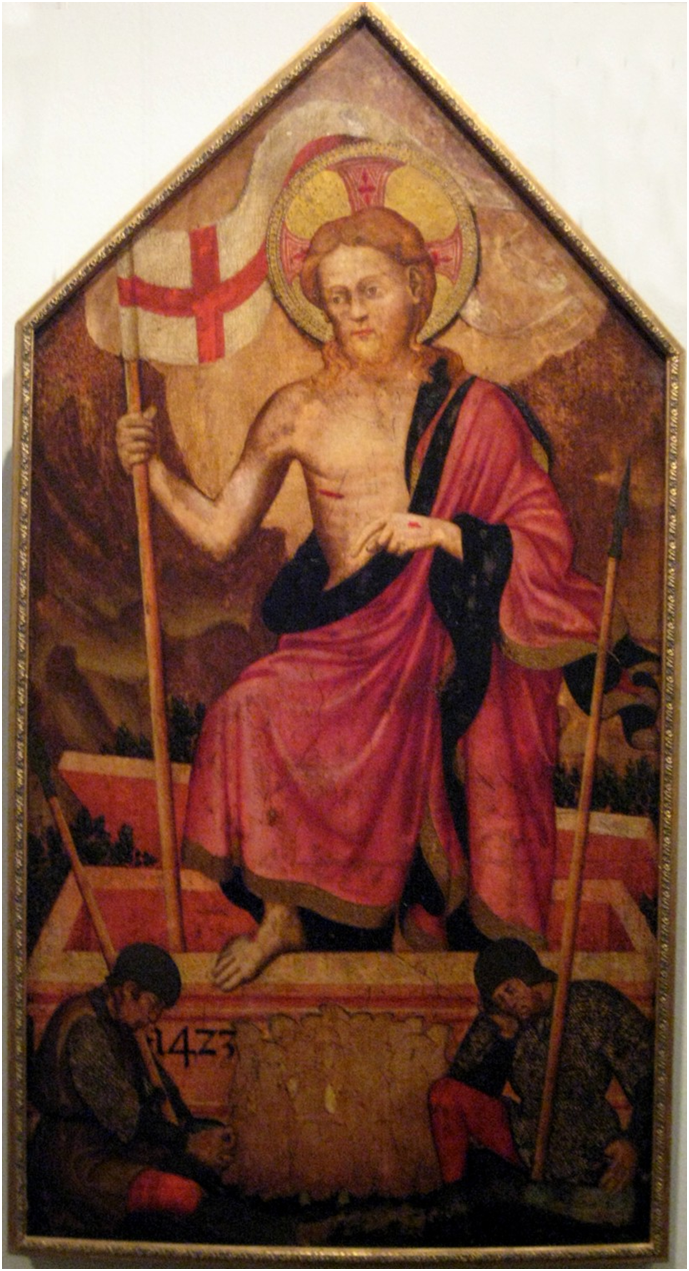
Monday, April 11, 2022

The Working Catholic: Easter Mess by Bill Droel


Advent is Lent; Christmas contains Easter and Easter contains Christmas. The Incarnation is Redemption and Resurrection.

Tom Stella (www.tomstella.org) of Soul Link in Colorado has a story: Once upon a time three monks were praying. The first imagined angels carrying him to heaven. The second imagined chanting in the company of angels and saints. The third, quite distracted, imagined the variety of food awaiting him in the refectory.  Later the devil wrote a report: I tried to tempt three monks but succeeded with only the first two.

The setting for the Christmas story (a crowed hotel, a manger and the sheep) conveys the truth of the Incarnation. God enters the human condition in a humble way. God lurks in ordinary circumstances. God keeps company with imperfect people. God awaits us in the refectory or the restaurant.

The Easter setting (dinner in an upper room, a traitor, a denier, a dusty courtyard, a heavy rock) should convey the same truth. But for some, the glory of the resurrection means God is back in God’s proper, serene, otherworldly place. The temptation about Easter is to thoroughly split the heavenly from the earthly, the spiritual from the material, the soul from the body. The messiness of Christmas and God’s Incarnation can be lost in the exhalation of Easter.

To keep the Incarnation in Easter, the evangelists insist on the bodily resurrection of Jesus. He ate, he conversed and he visited normal places. He invited Thomas to touch his physical body; saying in effect, I am not a ghost. Nonetheless a major heresy, Gnosticism, made significant inroads into early Christianity. This heresy teaches that Jesus was/is pure spirit and that briefly he was play-acting as a human. Gnosticism finds a companion in Platonic philosophy which asserts that the abstract and spiritual is superior to the material. Today this dualism with its superior spiritual themes is called New Age.

Some Christians make a similar mistake in equating the Resurrection with some kind of resuscitation. These Christians sometimes suppose that their heavenly existence is an identical continuation of earthly life with picnics, sports events, the same body but no illness. To counter this impression, the evangelists make it clear that the disciples do not at first recognize the resurrected Jesus. His body is different. Their resurrection faith emerges in conversation and tactile experience.

Let’s admit it is difficult to maintain awareness of the Incarnation. It is tempting to treat Christian faith as otherworldly. It is tempting to relegate God to a spiritual realm where angels sing and to not appreciate a hint of God in the dining hall. It is tempting to separate the Resurrection from the sheep and jostling crowd in Bethlehem. It is tempting to feel closest to God in some state of pure adoration.

It is, let’s admit, difficult to experience the resurrected Christ over on Kedzie Ave. near 61st St. where the homeless make their way, never humming a hallelujah chorus. It might be difficult to experience the joy of resurrection at the family’s Easter brunch where a loudmouth uncle repeatedly makes stupid comments. It might be difficult on Easter Monday to believe that the resurrection has anything to do with the petty resentments that pervade the office.

But Christ was born, Christ rose and Christ lives in ordinary comings-and-goings. Christ hints at glory in broken people, ambivalent settings and at odd moments. To stay attuned to the eternal joy of Easter requires the simplicity and patience of the first witnesses in Bethlehem. The heavy stone across the tomb is like the wood of the manger—materials essential to God’s plan of salvation.

Droel edits a newsletter on faith and work, INITIATIVES (PO Box 291102, Chicago, IL 60629).

Thursday, March 24, 2022

Mother Earth Nurturing Peace in a Time of War and Destruction


Sosegado:  Nakal Kolonton

“Está sentado mi corazón”

 An ancient Mayan image envisoned by Naúl Ojeda, Diccionario del Corazón, by Robert M. Laughlin, Smithsonian Institute, Taller Leñateros, 2002.

Monday, March 14, 2022

An Angry Mother Earth Over the Destruction of Creation by War and Greed


Encenderse de ira:  

Xch'ach'on kolonton,  "Es un enjambre mi corazón"

Aflame with rage, "My heart is in a swarm"


An ancient Mayan image envisoned by Naúl Ojeda, Diccionario del Corazón, by Robert M. Laughlin, Taller Leñateros, 2002.

Wednesday, March 2, 2022

The Sacred Earth and Irish Celtic Spirituality


Only a fool would fail

To praise God in his might

When the mindless birds

Praise Him in their flight.

Anonymous (Ancient Irish poem translated by Brenden Kennelly)


The global crisis of climate change, which is causing destruction of flora and fauna is life threatening to humanity and to all of global creation. “Mother Earth is the focus and the sacred container where the current spiritual adventure is to be played out. “ (Fox)   Without getting into specifics, Hans-Otto Poertner, co-chair of the United Nations’ Intergovernmental Panel on Climate change, says “the science is clear that there are limits – to what key ecosystems, species and humans can withstand.” (MJS,  p. 4A )

What is the role of faith? Joe Hill, the labor martyr, says, “Religion is pie in the sky.”  Joe Hill’s notion of religion comes from the current dualistic spirituality separating nature into natural and supernatural.

 Dualistic spirituality originates with St. Augustine and his Platonic theology that is spiritualism without grounding.  Saint Patrick of Ireland saw nature as the revelation of the Creator.

  “There is something peculiarly attractive about the Christianity of the early Celtic speaking peoples, which continues to exercise a considerable fascination on many today.  … The intricate, interweaving designs and natural motifs [of the Gospel illustrations] convey the impression of a religion that is in close dialogue with nature rather than withdrawn from it;…” (Celtic Spirituality, p. 3)  


BOOK OF KELLS


St. Patrick is the patron saint of Ireland (c. 385-461).  He was a slave, a worker, a shepherd who, under the nighttime sky, tending his flock, was well aware that the earth was part of a bigger universe, the cosmos.  Augustine by contrast was an aristocratic academic.  Ungrounded Platonic ideas shaped his theology. 

For Patrick the Creator, Christ, the Spirit is everywhere in nature.   

I arise today                                                        

Through the strength of heaven;                                                                                                                                                                                                       Light of sun,                                                                                                                                                                                                                                        Radiance of moon, 

Splendor of fire,

Speed of lightening,                                                                                                                                                                                                                                                    

Swiftness of wind,                                                                                                                                                                                                                   Depth of sea,                                                                                                                                                                                                                              Stability of earth,                                                                                                                                          

Firmness of rock. 

(From St. Patrick’s Breastplate, Cahill, )


Irish spirituality can be seen in the following Irish leaders in faith. 

Saint Brigit was the abbess of Kildare, governing a large territory of Ireland.  She was referred to as a pre-Christian Irish fertility goddess because of a repeated emphasis on her miracles that involved the production of food or animal husbandry. (Celtic Spirituality, p. 33)

In direct contrast with Augustine, Celtic theologian Pelagius had a different understanding of faith. (354-420 AD) Pelagius did not agree with Augustine’s insistence on ‘original sin’ as the cause for Christ’s incarnation.  (Celtic Spirituality, p 56-57.)  Redemption is the responsibility and the thrust of humankind and nature. 

A later Celtic theologian Scottus Eriugena delivered a sermon (#14) [815 -877 AD] (Celtic Spirituality, p. 423) which reflected a Johanine background.  It showed an affinity with his thoughts and awareness of the presence of the divine in the living forms of the earth.  Scottus Eruigena was invited to teach on the continent by Charles the Bald.  Both Scottus Eriugena and Pelagius were condemned by Rome.  John Scottus Eriugena is not to be confused with John Duns Scottus (1255-1308 AD). The name ‘Eriugena’ refers to Scottus being from Ireland.  John Duns Scottus is from Scotland. 

 Irish theologians took part in the Spanish renaissance of the 12th and 13th centuries.  Michael Scot and Peter of Ireland strongly influenced the young Thomas Aquinas in his early studies at Naples.  Propositions asserted by Thomas were condemned in 1277 by the Bishop of Paris, Stephen Tempier, as being materialistic.

Missionaries of Celtic spirituality led by Saint Columbanus spread through the continent and were especially effective in the Rhine Valley.  The theology of Meister Eckhart, Saint Francis of Assisi, Hildegard of Bingen and the Beguines were influenced by Celtic spirituality.


(The Course of Irish History)

These thoughts on Irish leaders teach us our role in the challenge of the climate crisis.  What does faith have to offer?  The motivating power of charity, love of God and creation, is the road to redemption.  “You need not just incremental change,” said Debra Roberts, a South African environmental scientist, at the United Nations Foundation briefing.  “You need systemic change.”  (MJS, p. 4A)

Greta Thunberg tells us, “Hope doesn’t come from words,…,Hope only comes from actions.”  (goodreads.com)


Resources

Matthew Fox, Order of the Sacred Earth,Monkfish Book Publishing Company, New York.

Milwaukee Journal Sentinel, UN Report on Climate Change Will Be Grim, February 15. 2022.

The Classics of Western Spirituality:  Celtic Spirituality, Thomas O’Loughlin. Paulist Press, 1999.

The Penguin Book of Irish Verse, introduced and edited by Brendan Kennelly, Penguin Books, England,1970.

How the Irish Saved Civilization, Thomas Cahill, Doubleday, New York 1995.

The Course of Irish History, edited by T.W. Moody and F. X. Martin, The Mercier Press, Cork, 1967.

goodreads.com)

James A. Weisheipl, O.P. , Friar Thomas D’Aquino, his life, thought and works, Doubleday, New York, 1974.

St. Patrick of Ireland:  a biography, Philip Freeman, Simon & Schuster, New York, 2004.


Thursday, February 3, 2022

The Working Catholic: Social Doctrine, Part Five by Bill Droel


    Catholicism ducked its appointment with modernity for about 400 years. Not until Vatican II (1962-1965) did Catholicism open the door to dialogue with the modern world—not a wholesale acceptance of every modern trend, but an engagement conducted with patience and sophistication.

    Catholicism opposed the Protestant Reformation (from 1517) because it was part of modern trends of individual standards, of sundry forms of worship and of authority structures unattached to Catholicism. Catholic officialdom was threatened by these and other emerging liberal values, including government autonomy, by professions that claimed their own independence and by secular culture. The violent anti-clericalism of the French Revolution in 1789 justifiably added to Catholicism’s fears. When the French monarchy was briefly restored, many Catholic leaders embraced it with a right wing, royalist mentality. However, by 1905 France firmly accepted modernity and its concept of autonomous society (laicite).

    The Catholic/modern dialogue proceeds in fits and starts. Even today some Catholic leaders inappropriately revert to blanket condemnations, foregoing sincere dialogue with those who disagree. Yet to be fair, on several topics Catholicism’s caution about modern trends has proved prophetic.  

    In 1891 Pope Leo XIII (1810-1903) inaugurated the formal body of Catholic social thought with his encyclical On the Condition of Labor. It condemned Marxism, a modern materialistic philosophy. To do so, Leo XIII reiterated a qualified approval of private property. As it turned out, communist collectivism oppressed rather than liberated many. Leo XIII was likewise prophetic in his condemnation of the modern materialistic philosophy of laissez-faire capitalism—what people today call neo-liberalism. An economy that spins with only the force of finance creates a hierarchical system in which the majority cannot meaningfully participate.

    At its best the Catholic tradition fosters a reasonable approach with which to argue intelligently and temperately with the world, explains Fr. William O’Neill in America (12/21). The differences about current issues must respect common rules of the game, he explains. The conversation must be conducted in a common grammar.

    For example, meaning must be moored to truth. The rules require that validating important matters solely on one’s opinion or one’s feelings is inadequate.  Truth is arrived at through evidence. Truth-seeking is not a performance, not an avenue for vindication or a way to process resentment. An honest dialogue about modern issues has to forego cancelling the speech of others. It has to be void of self-righteousness. There is room for multiple interpretation of facts but there is no such thing as alternative facts. At the same time everyone has to understand that while the rules of truth-seeking are permanent, tomorrow’s discovery or future evidence can change yesterday’s conclusion.

    ’Neill also reminds us that rights are not the same as interests. An individual right is normally a claim mixed within other rights. That is, each right comes with duties or considerations. Contrary to neo-liberal philosophy, a conflict of claims is not settled by calculating the greatest good for the greatest number of people. Decisions in the real world have to aim toward the common good; the good outcome that is only obtained if people cooperate. The decision-making process is informed argument, not outrage.

    Finally, as O’Neill mentions, Catholicism or any other religion dialogues in the public square with reasoned language, not insider language. Sectarianism only isolates a religious voice. O’Neill uses abortion as an example. Catholicism opposes direct and purposeful abortion not as “one sectarian interest among others.” The opposition is not a Catholic position, per se. To influence the world, positions on abortion or other issues, have to be expressed in universal terms. And so in a public dialogue O’Neill would put it this way: All people have a basic right to life and a right to the means of sustaining life—a right to basic nutrition, to adequate health care, etc. The “strongest case against abortion,” he says, is an argument based on “upholding the rights of all.”

    Catholic leaders and ordinary Catholics can be as strident as anyone else, indiscriminately maligning groups of people. They can also shortsightedly put their faith in authoritarians or phony media personalities or corrupt business leaders. They can hurt the innocent. They can wash away their public sins as mere failures in management. Yet with humble application of our social doctrine Catholics can help improve business conduct, labor relations, social policy, care for the environment, respect for inherent dignity of each person, international affairs, the nurturing of children and more. A Catholic contribution to the world presumes, of course, that Catholics know their social doctrine and are capable of strategically using it. To be continued…  
 

Droel edits a free newsletter on faith and work, INITIATIVES (PO Box 291102, Chicago, IL 60629).

Sunday, December 19, 2021

The Battle for Christmas by Bill Washabaugh


It’s Christmas week here in Milwaukee. The streets are lighted, the houses are decorated, and all is ready for a collective effervescence of peace and good will. It’s a time when family members come together to bask in their reciprocal generosity. What a wonderful life...or is it?

 The traditions of Christmas here in the northern cities of the United States have a long and wondrous history, but maybe not so wonderful.* And it is worth reflecting on this history, lest we allow ourselves to be simply swept along by the tide of the season, the, uh, yule tide.

 Between 1500 and 1800 in Europe and America, Christmas meant one thing and one thing only, getting drunk. The baby Jesus may have been back there somewhere, but way back. What was front and center was a good long tug at the bottle. The liquor helped dull the pain of the season.

 The pain? Around 1800, the collective pain was obvious. The rivers froze which meant that the mills stopped working, which meant that the laborers were laid off, which meant that their families went hungry. In their poverty, most workers had little else to look forward to but booze.

 The liquor loosened folks up and, as a result, they acted out more freely in public. They developed a tradition of going door-to-door, begging—no, demanding—gifts from wealthy citizens. Such behavior echoed the long-established table-turning that had prevailed during the carnivalesque Christmas celebrations of the late Middle Ages. That is, the poor became demanding and the rich became acquiescent for just this short season of the year. The powerless became momentarily powerful. 

 But, such behavior was getting out of hand by 1820. It was about then that Clement Clarke Moore wrote “A Visit from St. Nicholas” (‘Twas the Night Before Christmas), a poem that he and his cronies hoped would both entertain New Yorkers and dial down the turmoil of the season.

 Central to his story is St. Nick, Santa Claus, a cross-over figure if ever there were won. Nick wore the ermine-tipped red-velvet of a bishop, signs of his elite status. But he was dirty and he smoked a short-stem stump of a pipe, signs of his low-class affiliation. With this combination of high and low characteristics, he passed as neither drunken carouser nor haughty mill-owner, but as an in-betweener. He was the perfect figure around which to organize a Christmas cease-fire.

 This in-betweener was altogether acceptable as a magical elf who could silently infiltrate a house, where he could give gifts instead of demanding them. He was neither patron nor pauper, but a bit of both. And being a bit-of-both, he managed to appease the poor, while simultaneously calming the fears of the well-to-do.

 Besides creating and positioning this new Christmas hero, Moore engineered a second feature for the Christmas holidays, an ingenious shift of focus away from the warring social classes outside households and toward the children within households.

 In the past, children had been treated as simply dependents, not much more distinguished than household servants. But now, by making them central to the holiday, Moore reconstructed the carnivalesque power-reversals of yore, defusing class conflicts, and infusing family life with a central importance it never had. Rather than having the poor on the street demanding gifts from the wealthy, he featured children in the household receiving gifts and feeling like kings. 

 The empowerment of children that he fostered seemed to suit bourgeois sensibilities ever so much more comfortably than did the erstwhile momentary empowerment of the lower classes. And, voila, the ferocity of the streets was kept at bay. Thereafter, Ma in her kerchief and I in my cap could relax, get fat, and watch the world go by.

 So, here we are in Milwaukee, dizzied by the lights and sounds of Christmas. We are eager to buy gifts for the kids, and we are suffused with a sense of our own generosity towards mankind. But, after looking into the history, we can't help but wonder...

 *Stephen Nissenbaum, The Battle For Christmas, 1996.


Thursday, December 16, 2021

The Working Catholic: Lockout by Bill Droel


Kellogg has used the lockout tactic before. In October 2013 the cereal company locked out its 220 Memphis employees. Issues included mandatory overtime and benefits. The situation remained until August 2014 when a federal judge ruled that in this case the tactic was illegal. The judge ordered that employees be brought back on the job with no penalty.

Now Kellogg has locked out 1,400 employees at four plants. The main issue is a two-tier pay scale—newcomers get less; as old timers retire the total wage and benefit expense decreases.

Employers who use the lockout tactic claim that it gives them leverage in negotiations. To stay on the legal side during a lockout employers must publically say that the door to negotiations is always open. A lockout is becoming a popular maneuver.

In 2011 the NFL locked out its players for 18 weeks. The NBA had a five month lockout the same year. In 2012 the New York City Opera locked out its performers. The Minnesota Orchestra did the same the following year. Also in 2013 Crystal Sugar in Minnesota locked out 1,300 employees. In 2015 Allegheny Technologies, a steel firm, locked out 2,200. And in 2018 National Grid, a Massachusetts gas company, had a lockout of 1,200.

To all of us in the Hot Stove League the most pressing labor-management disagreement these days involves the lockout of baseball players.

The lockout tactic is foolish without the threat of permanent replacement workers. On its own a lockout doesn’t make sense because a company would go out of business if it didn’t allow workers to come to the jobsite. Sometimes the threat of replacements is implied. In the current Kellogg dispute ownership makes the threat explicit.

Catholic doctrine has something to say about both lockouts and permanent replacements. First, however, here’s what our doctrine does not say. Catholicism gives general, abstract guidance on what constitutes a just wage and acceptable benefits. Catholicism does not though endorse the specifics of any employer’s contract proposal in any given situation. Catholicism does not endorse the specifics of a union’s counter-proposal. (This applies, by the way, even if the employer is a bishop and the employees are gravediggers or janitors or teachers.)

Catholicism says that negotiation (which depending on circumstances can be smooth or hardball) is crucial. Totalitarianism (total corporate, total state or total both) is not conducive to a healthy society and holy people. There must be some form of negotiation, some form of democracy. Collective negotiation is the countervailing force that holds off totalitarian impulses. Catholicism strongly asserts that employees have a natural right and duty to meaningfully participate in the design and the benefits of work in some measure.  

A lockout and its threats break faith with an acceptable negotiation process. Cardinal John O’Connor (1920-2000) of New York testified in 1990 to our U.S. Senate Committee on Labor. He introduced himself as speaking as a citizen and an employer. He also said that as a bishop he is a mandated moral teacher. The context was a dispute at the Daily News in New York City. Ownership threatened permanent replacements.

“It is useless to speak glowingly” about rights if either “management or labor bargains in bad faith,” O’Connor said. “In the case of management [it is] a charade of collective bargaining and a mockery [for management] with foreknowledge… to permanently replace workers who strike.”  In 1999 O’Connor repeated Catholic principle, writing to nurses: “I remain strongly committed to a policy of no permanent replacements.”

O’Connor’s use of the phrase moral foreknowledge is important. A company that threatens the use of so-called permanent replacements knows the tactic is not an end in itself. Whatever the outcome of the lockout/permanent replacement gambit might be, its real purpose is to end possible negotiations and soon enough to bust the union.

To conclude on a positive note it is worth keeping in mind that the vast majority of contract negotiations are completed without any job action whatsoever. Yes, some posturing occurs; some swearing perhaps. But day-in-and-out negotiations are not newsworthy because nothing dramatic occurs outside the bargaining room and apart from the employee’s vote.

Droel edits a print newsletter on faith and work, INITIATIVES (PO Box 291102, Chicago, IL 60629)