Friday, July 18, 2014

THE PILGRIMAGE CONTINUED - ANTIGUA GUATEMALA

   Antigua - founded in 1543 and named Santiago de los Caballeros. 


The city of Antigua was the third capital of the colony of Guatemala.  This Spanish colony included almost all of Central America including Chiapas which today is part of Mexico.  After devastating earthquakes in 1773, the capital of the country was moved to Guatemala City.  Many Guatemalans abandoned the city of Antigua, but some of the ruins of colonial buildings remain.  The name of the old capital, Santiago de los Caballeros, was changed then to Antigua Guatemala (the old Guatemala). 


Where have we been and where are we going?

   We arrived on Tuesday of Holy Week in Antigua to experience the famous processions which rival Seville, Spain as a tourist attraction.  We found ourselves enveloped in late medieval architecture, and anticipating our participation in late medieval piety with the processions and rituals. The small town of about 35,000 is packed with visitors from all over the world for Holy Week.


                                  Preparing for the Good Friday Processions in Antigua


The baroque architecture of the ruins of the 1773 earthquake is still easily perceived, and some of the buildings have been restored to look like the originals.  The dominating architecture transports you back to the days of the Spanish empire.


Bartolome de Las Casas, O.P.   

   Joanne and I went for a brief walk in the city.  We came upon the Merced, the remains of a church and convent built by the Mercedarian Fathers from 1749 – 1767.  


                                              Church of the Merced in Antigua

Despite being constructed to withstand earthquakes, the complex was badly damaged in the 1773 earthquake.  The restored version of the church is a close version of the original building.  

   In the front of the building is a statue of Bartolomé de Las Casas, O.P., Bishop of the area from 1543 to 1547. 


                                     Statue of Bertolome de las Casas outside the Church of the Merced

He was called ‘Defender of the Indigenous People.’  Opposing the prevailing theology of the day, Las Casas insisted that the Indigenous were fully human and had full rights as human beings.  He denounced the ‘encomienda’ system established by Imperial Spain for the Spanish Americas in 1502.  According to this system the encomendero (owner) was given an allotment of indigenous people to protect and instruct in the Roman Catholic faith.  In return the indigenous were to provide labor and tribute to the encomendero. A similar program was used in Spain in the reconquista (reconquest) of Muslim territory.  Gustavo Gutierrez writes that a key reason for Las Casas’ fierce opposition was that “these laws perpetuate and definitively establish the system of distribution (of native people), or encomienda, that is the servitude of the Indians and the exploitation of their labor.”  (Gutierrez, Gustavo, Las Casas, Orbis Books, Maryknoll, New York, 1993, p. 284.)  

   Las Casas instructed confessors to refuse absolution to encomenderos unless they freed the Indians working as slaves on their work sites. (Ibid. p.33) The nearby provinces of northern and southern ‘Vera Paz’ (true peace) were named reflecting the quality of life advocated by Las Casas and his Dominican Friars.

    The founder of Liberation Theology, Peruvian Gustavo Gutierrez, notes that Las Casas insisted that the colonial economic system be completely abandoned not merely adjusted. (Ibid. p. 288)   United States’ global neo-liberalism of today is a similar economic system that desperately needs to be changed.  Gutierrez refers to the Latin American Bishop’s documents from Medellin, Columbia (1968) and Puebla, Mexico (1979), which advocate change in political and economic structures, to demonstrate that the Church’s tradition of justice for all, preached by Las Casas, continues. (Ibid. p. 286) 

   We toured the beautiful baroque Merced Church.  Inside parishioners were preparing their float for the processions.

   Three of us decided to go to visit the Santo Domingo Church; we thought it was a church, but it turned out to be a luxury hotel and a museum.  The original church and Dominican convent were destroyed in the 1773 earthquake. Remains of the original church can be found in the hotel-museum complex.


                   Dominican Shield displayed in the Hotel/Museum of Sancto Domingo in Antigua

   I talked to a museum guide about Bartolome de Las Casas and also the massacres of the indigenous during the civil war.  I asked him if he felt that revenge was necessary.  He thought awhile and responded, “No! Father Bartolomé would say no.” I asked another Guatemalan about the guide’s response and he said, “It’s a Ladino (upper class) comment – he’s told you what you wanted to hear.”


Holy Thursday at the Antigua Guatemala Cathedral

   On Holy Thursday we went to Mass at the Cathedral.  We arrived early, but the plaza in front and the church itself swarmed with people.  We saw room available in the front of the church; Joanne and I went up to claim the seats, but we were told they were reserved.  We went to a side aisle; our companions remain in the back standing.  At least we had the wall to lean on during the long ceremony.  The entrance procession included the Bishop, clergy and well dressed lay leaders of the church, certainly Ladinos or upper class.  They took the reserved seats in the front near the altar.  The Bishop washed the feet of the important Ladinos in the Holy Thursday ritual which attempts to enact the story of Jesus washing the feet of the Apostles at the Last Supper.

   The readings of Holy Thursday are selected to point to key understandings of Salvation History.  The homilist, the Bishop of the area, chose to emphasize the importance and the need for priests.

   It is ironic that the myth of the Eucharist and the Catholic priesthood was in the process of collapse during the 16th century in northern Europe yet still remains viable in Guatemala with similar 16th century trappings.  Is it that some Latinos & Ladinos, by necessity are better at salvaging the good from a myth and simply ignoring the obvious absurdities? 


   The myth of the priesthood and the Eucharist establish an upper class institution yet still were a challenge to the racism and greed of the U.S. dominated, global economic system.  The numerous martyred priests and religious are witnesses. Is it reasonable to ask: do the myths enveloping Jesus, the young Jewish handyman executed by imperial Rome, in one way or another make sense of our lives politically and personally?    

Thursday, July 3, 2014

SANTIAGO ATITLAN


Jesus returns to Jerusalem...

Then taking the twelve aside he said to them, “Now we are going up to Jerusalem, and everything written by the prophets about the Son of Man is to come true. For he will  be handed over to the pagans and will be mocked, maltreated and spat on, and when they have scourged him they will put him to death; and on the third day he will rise again.”  But they could make nothing of this; what he said was obscure to them, they had no idea what it meant. (Luke 18, 31-34)


                                               Lake Atitlan


   We went by van on a short trip to parish of Santiago Atitlan. Both San Lucas and Santiago are on the picturesque resort Lake Atitlan.  


                             Lake Atitlan - Guatemalan Resort Area

   Santiago Atitlan was the parish of Father Stan Rother from Oklahoma City.  Father Rother was murdered by the Guatemalan military in 1981.  We visited his church and the rectory where he was killed.


                            Patio of Father Rother's Santiago Church

  The Pastor of San Lucas Toliman, Father Gregg Schaffer, warned his fellow pastor at Santiago Atitlan, Father Stan Rother, that the military was after Father Stan.

   Father Rother was not politically ‘concientizado.’ There was nothing reported about him conducting clandestine meetings.  No one says they remember Father Stan discussing the 1968 document of Medellin promulgated by the Latin American Bishops demanding changes in political and economic structures.  The military targeted the pastoral priest because of his unrelenting support for his cherished parishioners. During an army attack Father Rother sheltered hundreds of people in his church.

   At the advice of Father Gregg Schaffer, Father Stan Rother returned to Oklahoma City.  He was invited to preach at an Oklahoma City church and he questioned Reagan’s claim that the communist threat in Central America justified the massive military assistance given to these countries.  A parishioner reported Father Stan’s sermon to the Guatemalan embassy. 


                    Memorial to Father Stan Rother, Santiago Church

   Father Rother couldn’t be away from his beloved people while they were under attack.  He returned to Santiago Atitlan to face the military bent on genocide.  Within a few months Father Stan was murdered.  His body was sent to Oklahoma City for burial but his heart remains enshrined in the church at Santiago Atitlan. 


Nakal kolonton – My heart is at peace

*Laughlin, Robert, with woodblock prints by Naul Ojeda, Diccionario del Corazon, from a Mayan dictionary compiled in 1599 by a Dominican Friar - metaphors of the heart with the Spanish medieval translation and the modern Spanish version.  Taller Leñateros, San Cristobal de las Casas, Mexico 2003.


     The name of the town 'Santiago' is significant.  Many cities in Latin America are called Santiago.  The name refers to St. James; some scripture scholars would speculate that St. James was Jesus’ brother and a Pharisee.  A legend tells us that the remains of St. James, after martyrdom, were sent miraculously from the Holy Land by boat to northeastern Spain.  James arose from the dead to lead Christians to a military victory over the Muslims.  There is a city in Mexico called Santiago Matamoros – St. James the Muslim killer.  Churches in Spain and Latin America have statues and paintings of Santiago Matamoros riding on his horse and wielding his sword.
 
   I didn’t notice a painting or statue of Santiago in Stan Rother’s church or town.  Again it was perhaps because of being overwhelmed by the stories of Rother’s murder and the slaughter of the indigenous in the area.  I wasn’t looking for Santiago on his horse; after all we couldn’t blame him … or could we?

   Matamoros is the name of a military post and prison in Guatemala City.  General Efrain Rios Montt was taken to Matamoros Prison in 2013 after being convicted of genocide.  A companion on the trip recalls the statue of Santiago Matamoros outside Stan Rother’s church, but does not remember a statue or painting inside the church.

   Our next stop in Santiago was the Peace Park.  (Parque de la Paz)  At first I didn’t realize it, but just our presence was an acknowledgement of a victory for the people and a sign of hope for Guatemala.  Two Guatemalan leaders, poet and theologian Julia Esquivel, and the head of the water project in Chutzoropi, stated unequivocally to us that there was no hope for Guatemala through the government.


                                   Santiago Peace Park

   We experienced a sign of hope when we visited the Peace Park.  The people of Santiago Atitlan successfully rejected military force – the power of the government.

   On December 1, 1990 a group of soldiers from the local military post were out partying and got out of control.  They killed one of the townspeople who were trying to constrain them.  In the morning thousands marched to the garrison to demand an end to the murderous rampaging of the military in Santiago.  The townspeople were met with gunfire; eleven were killed and several injured.    

   Community leaders demanded a meeting with the Guatemalan government.  With international support, an agreement was reached permanently removing the military from the town of Santiago.


                          Graves of the massacred at the Peace Park
   

   The graves of those killed in the massacre are in the Peace Park along with a plaque stating the agreement of the government to remove the military from the area.  There are no religious symbols such as Santiago Matamoros. However, every year on December l, a celebration takes place to remember the victory of the people; part of the celebration is a Catholic Mass.  
  

    Peace Park, Saturday, December 2, 1990, Panabaj, Santiago Atitlan


SISTER, WOMAN OF FAITH 
by Julia Esquivel, in exile, New York City.

I think of the Indians
driven from Manhattan with blood and fire
and my heart
crushed by sorrow
along with other hearts in solidarity
struggles to turn back the claws of Capital
poised over Santiago Atitlan ...

The homeland is an altar – not a pedestal.


The Certainty of Spring, The Ecumenical Program, Washington, D.C. 1993

Thursday, June 26, 2014

SAN LUCAS TOLIMAN, Pilgrimage continued...


   On Palm Sunday we headed south to the Province of Solola to visit the parish of San Lucas, Toliman.

The winding hillside road just outside of Toliman was blocked by buses.  The buses were transportation for teenagers at a regional retreat at San Lucas Toliman.  Parish officials estimated that there were over 2000 youngsters from the region attending.

   When we arrived at the parish of San Lucas we were invited to dinner in the parish hall.  We met two young women who volunteered at the parish.  They talked about the massive retreat that we encountered in terms that the ‘evangelists’ would use.  One, who graduated from the conservative Roman Catholic Franciscan University in Steubenville, Ohio, was director of volunteers for the many parish projects. San Lucas had not experienced the devastation we saw in El Quiche, Espiritu Santo.

   The moving force behind the outreach of the parish was a priest from New Ulm, Minnesota, Gregg Schaffer.  He had remained neutral during the civil war, but had contacts in the government and was alerted when people in the San Lucas area were targeted.  “Father Gregg saved many lives by warning people of the government’s intentions,” we were told. Among many projects as a priest at San Lucas, he established a medical clinic, a school, a coffee project, a women’s center, and a reforestation center.  He asked his parishioners, what do you need?  Then he went to work.  Schaffer questioned financially desperate coffee growers how much they needed for their coffee in order to survive.  They told him, and he established a coffee cooperative to pay the requested prices to the growers. When peasants were thrown off the land, he bought large tracts of land for them to farm. A baby died in his arms and he responded by establishing a medical clinic.  Financial support came from pleas to faithful funders in the Minneapolis area.   Schaffer was a priest well versed in other world theology, but was basically a Minnesota pragmatist with a strong sense of survival and social justice.

   Gregg Schaffer died in 2012 after almost 50 years of ministry in Guatemala.  At San Lucas they are not sure that the projects he started will continue without him.


   San Lucas was a busy place preparing for end of the week rituals of Holy Week.  A companion and I went into the Church to observe the Holy Week activity.  I pointed out a piece of artwork on the inside wall of the Church.  It was a plaster representation of the Trinity – the triune God, a basic symbol of Christianity.  In the background was the Father with a black beard – very Spanish.  In front was a bird, perhaps a dove, (definitely not an eagle) and also in front, a crucified Jesus.  We asked what it meant.  A young man, who was working on a procession float in the middle aisle, responded. “That is God” he said.  “But then God is three,” I replied.  “No!”  God is one with three aspects, the Father, Son and Holy Spirit.” “Could a woman represent one aspect such as mother?” “No!” was the answer. 


   We let it go and looked at the float they were preparing.   The float was almost as wide as the middle aisle and about 15 ft. long.   At the head of the float was a large triangle (the trinity) with the ‘eye of God’ in the center.  At the rear was a boat carrying Jesus and companions, perhaps a reference to the storm on the lake.  (Matthew 8:23-27)   I did not want to strain the good will of the people by asking more questions, but I wondered if ‘the eye’ meant that God knew about the genocide.            

   The preaching in the Christian churches presents the Gospels as historical and confuses the mythical – theological with history.  The Holy Week processions in Guatemala seemed to do the same, but there is a difference in Faith and faith or belief in myth.  Scripture scholar, Jerome Murphy O’Connor, said the New Testament writers were not historians, but theologians who presented an understanding of Faith to particular audiences with their stories of Jesus. The accounts of the passion of Jesus differ and attempt to portrait who Jesus was and his mission.  If the passion stories have the character of a myth, what value do they have?  It could it be destructive; for example a cause of the holocaust.

   Since Vatican II Holy Week processions and passion plays have been carefully crafted not to portray the Jews as the executors of Jesus.  In the Holy Week ceremonies in Guatemala I did not see anything that characterized the Jews as the killers of Jesus.

   Rudolph Bultman and his German colleagues debated the issue of the New Testament as myth during World War II and immediately after the war.  In the series of essays, Kerygma and Myth, (Edited by Hans Werner Barisch, Harper, New York, 1961) the war and the holocaust are not mentioned.  Bultman’s original essay in German was published in 1941.  For Bultman, Faith is an existential affirmation that Jesus is Lord and requires radical commitment to the Lord.  Faith, according to Bultman, is between the Lord and me.

   Holy Week in Guatemala prompted me to ask:  is Holy Week there portraying Jesus’ passion and resurrection as historical fact, a myth to be believed?... or simply quaint pageantry for diversion?... or something more?  


Next Posting: Santiago Atitlan, Rev. Stan Rother – Martyr, The Peace Park.    

Friday, June 13, 2014

The Parish of Espiritu Santo in Zacualpa, Guatemala


 From the depths I call to you, Yahweh.                                                         Lord listen to my cry for help!                                                                            Listen compassionately                                                                             to my pleading.                                                          (Psalm 130)   

   The next station on our pilgrimage was the church and grounds of the parish of Espiritu Santo in the town of Zacualpa in the Department of Quiché.  Here we experienced remnants of the war which killed 200,000 people, mostly indigenous. A companion commented, “We were innocent of the story and it is graphic and startling; they walked us through.”


  Next to the church is a large white cross about twenty feet high.  The crossbar displays the word ‘MARTYRES.’ The church grounds, the equivalent of a convent cloister, were the site of massive killings of indigenous people by the military.  Prisoners were tied to trees – tortured and murdered.  The ‘Santa Cruz,’ the holy cross, became real.

    Some were murdered and tortured in the church itself.  Statues and all symbols of Christianity were destroyed.

   Photos framed on the wall of the ‘cloister’ passageways showed the project of exhuming the bodies for proper burial after the peace accords.

   We were led to a small room off the ‘cloister.’  This was another site for torture and murder.  Torture instruments were displayed on the wall.  The horror of the place came home when we were told that the black stains on the wall were blood stains. At a corner of the room was a life size wooden statue of a Mayan woman on one knee lamenting the desecration of humanity. She is a contemporary ‘mater dolorosa.’

   We then went to a small building with a dirt floor for a prayer service.  Attention was directed to a topped well now functioning as a ceremonial fire pit.  A Mayan woman as official spiritual guide conducted the prayer ceremony at the side and over the fire pit. 


The well itself is significant. The guide explained that not only were people murdered and tortured, but the bodies thrown into this well and two other wells.  She gave us wax candles of different colors representing the diversity of the universe; our candles were lit and eventually placed in the center of the fire.  The wax melting together symbolized the unity of the universe.  We prayed.  After the ceremony, our guide thanked us for listening and understanding that the civil war was not war, but genocide – a revelation for most of us.   

   I asked a Guatemalan colleague - member of Voces de La Frontera - if the killing of the indigenous was really racism.  Couldn’t war on the indigenous be simply economic?  After all, the indigenous are diametrically opposed to some neo-liberal policies.  He said, “Racism is ‘infundido’ (inherent) in the Guatemalan upper class.”  In the U.S., to the extent we don’t care to know or care what happened to the indigenous in Guatemala, we internationalize our own inherent racism. Survival of the fittest capitalism is an excuse for racism and genocide.

   Despite war, the parish of Santo Espiritu flourishes.  The building was filled with people preparing for Holy Week.  The church has been repaired and replenished with sacred images.  The trees where prisoners were tortured and murdered have been cut down and replaced, but the stumps serve as a reminder.  We talked to students taking classes in hopes of entering high school and college.   It seemed to me that the Christian myth survived the onslaught at Espiritu Santo, and now has a new respected partner in Mayan spirituality to build a just society.

                     Ch ‘ilom kolonton – my heart is a warrior*

*Laughlin, Robert, with woodblock prints by Naul Ojeda, Diccionario del Corazon, from a Mayan dictionary compiled in 1599 by a Dominican Friar - metaphors of the heart with the Spanish medieval translation and the modern Spanish version.  Taller Lenateros, San Cristobal de las Casas, Mexico 2003.


Thursday, June 5, 2014

MAYAN SPIRITUAL GUIDES


 Our next stop was visit to a Mayan spiritual guide.  An unusual opportunity was presented.  Would you expect a visit to a spiritual guide of a pagan religion on a tour sponsored by Roman Catholic Religious?  It was an opportunity to compare myths.  Do they compete with each other or are they complimentary?

They raped our mother earth
when they stripped the southern coast
and changed the ecological balance
planting cotton to produce capital
Instead of sacred corn,
which sustains our people.

(Julia Esquivel, “All Guatemala is Rigoberta Menchu,” The Certainty of Spring, Ecumenical Program on Central America, Washington, D.C. 1993)


   We were warmly greeted by the Mayan spiritual leader, his wife and his son at their home and worship center.  There was an open “patio” area, a small room for prayer and reflection and a large room for instruction or discussion.  The large room was equipped with a projector and a large screen.  On display were specially shaped and colored rocks considered sacred.
 
   The video and the talk emphasized the Mayan belief in the oneness of being.  Rituals are held outdoors in the temple of nature itself. For the Mayans all of nature is sacred without distinct differences in value, hence the objection to indiscriminate mining and cash crop agriculture for export.  Mother Earth is sacred.

   Despite the peace accords of 1996 the racist war against the indigenous continues. In 2012 seven campesinos we killed by government security forces.  The indigenous were protesting government policy.   The Mayans ask an important question about their future and the future of the planet: “What will happen if the megaprojects of neo-liberalism succeed?”  (Estudio Sobre el Impacto de los Megaproyectos en  Relaceion a los Lugares Mayas, Santa Cruz del Quiche, 2012)


   The spiritual guide and a colleague were open to discussion.  I asked, if you do not believe that Jesus Christ is God and the savior of all, are you able and willing to collaborate with Christians?  There was dialogue for clarification, and the answer was yes.  The crisis presented by the global neo-liberal policy on mining, energy production, and agriculture has prompted workshops, sponsored by the Mayans, on how to confront the crisis.  Workshops have included leaders from various communities – “Evangelicos, Catholics, teachers, women and young people.” (Ibid)

   Are women permitted to be spiritual leaders?  The answer was yes.  Our spiritual leader’s wife was also a spiritual guide. At a future stop we would pray with a female Mayan spiritual leader at the site of a terrible slaughter of indigenous people in the church and church yard of the Roman Catholic parish – Espiritu Santo.


      From the beginning ‘till now the entire creation, as we know, has been groaning in one act of giving birth; we must be content to hope that we will be saved….           (Romans C. 8,  vs  20 – 25)

Saturday, May 24, 2014

OUR KIDS IN GUATEMALA


      Indian child                                                                                                 
      delicate sprig of violet                                                                                   
      with your breath sustaining                                                                           
      our poor faith                                                                                                                        the sunshine of Justice.  
      From The Certainty of Spring by Julia Esquivel, poet and theologian                                                       
  
   We, the people of the United States, created the situation in Guatemala by financing the 36-year civil war to impose Capitalism - so we own the problems – they’re sealed and paid for.
 

   Holy week is a festival in Guatemala.  The streets are shoulder to shoulder with people – vendors everywhere.  Kids with clever salesmanship sell craft items made by their families.  Some spoke in English, “You buy from me,… maybe tomorrow? Do you promise?”

   I asked a boy what the pageantry was about.  For me, he said, “Holy Week was the time to make a decision.”  “What decision?” I asked.  “Whether to be a Catholic or an Evangelical,” he responded.


  Although I had almost five years of experience in Bolivia and had traveled to many other countries in Latin America, I felt overwhelmed by the meeting with Julia Esquivel, by the discussion at NISGUA and by the trip to the Guatemala City dump.  By the time we reached the village of Santa Apolonia and the Milwaukee School Sisters of St. Francis’ Orphanage, I felt I couldn’t absorb more.  I took no notes; I have memories, but to be accurate and clear as possible, I interviewed Sister Marietta Hanus, S.S.S.F., one of the founders of the orphanage.  Sister Marietta now lives in Milwaukee and is a supporter of the Voces de la Frontera New Sanctuary Movement.


Sister Marietta explained that the story of the orphanage begins in 1981.  Milwaukee School Sisters of Saint Francis had a group of nuns in the municipality of Los Amates de Izabal.  The Milwaukee sisters intended to establish a Guatemala presence of the School Sisters of Saint Francis. S. Marietta did counseling and teaching at the convent.  The sisters also did pastoral work, but they were in the midst of the Guatemalan civil war.  Pastoral work based on “love God and love your neighbor” was subversive.  And then their parish priest was murdered.  The sisters had to leave Los Amates and go into hiding. Some went to Guatemala City, others to Honduras and Mexico. 
  
   The next year the sisters that were refugees in other countries reunited with their displaced sisters in Guatemala City.  A Guatemalan sister noted that the horrible war had destroyed many Guatemalan families, the basis of civil society.  It was decided to establish new homes for mothers widowed by the war and for the orphan children.  It would not be an institution or orphanage as such, so the name chosen was Homes of Our Lady of Guadalupe.  The Bishop of Solola provided land in the village of Santa Apolonia with a 99 year lease.  The buildings were constructed in 1985.


 The first children in the orphanage were from the village of Santa Apolonia and other children displaced by the war were soon added.  War widows were the family caretakers. In the following years the children were to take responsibility for family living and their future.  At ten years old they would decide on which training at the complex they wanted to pursue:   shoe making, sewing and tailoring, carpentry, or farming.  Children could stay until they were 18 years old.  Now there is a government law that the children are to be available for adoption, but the loss of one of the children from a community family can be disrupting.


Sister Marietta told some stories of the children, such as the twins whose mother died in childbirth.  The dad, a local farmer, could not take care of the newborns.  He would come with one of his other children to visit and he brought eggs to the Sisters in gratitude for caring for his sons.  The twins, David and Christopher, prospered at Guadalupe Homes and became competent workers.  One was skilled with computers and the other a mechanic.  

   One boy was the survivor of an automobile accident in which his whole family was killed except for his mom.  She was pregnant with him at the time.  The mom went into a coma, but the baby was born.  She was unable to care for the boy so he was taken in by Guadalupe Homes.  At baptism the baby boy was named Moses because he had been saved by God from death.
   
   Lia, another orphan, was taken into town so she could see a doctor. When she heard marimba music playing on a radio, she became very upset and cried, “That was the music I heard when they killed daddy.”   When soldiers appeared at the community gates she pleaded, “You’re not going to kill us like you did my daddy.”

   What about the soldiers?... they too are just kids recruited from the countryside.  During the Holy Week pageantry they were very visible on the streets.  I asked one very young soldier, armed with an automatic weapon, if it was true that in the past the military massacred people in various municipalities.  He said, “Yes.”  I asked if he also would do that – he said, “I don’t know.” 

When they reached the place called the Skull,                                                   they crucified him and the criminals there,                                                          one on his right, the other on his left.                                                                Then Jesus said, “Father forgive them                                                                for they know not what they do.”

(Luke 23, 33-34)   


Sunday, May 11, 2014

A RENOVATION OF FAITH, continued


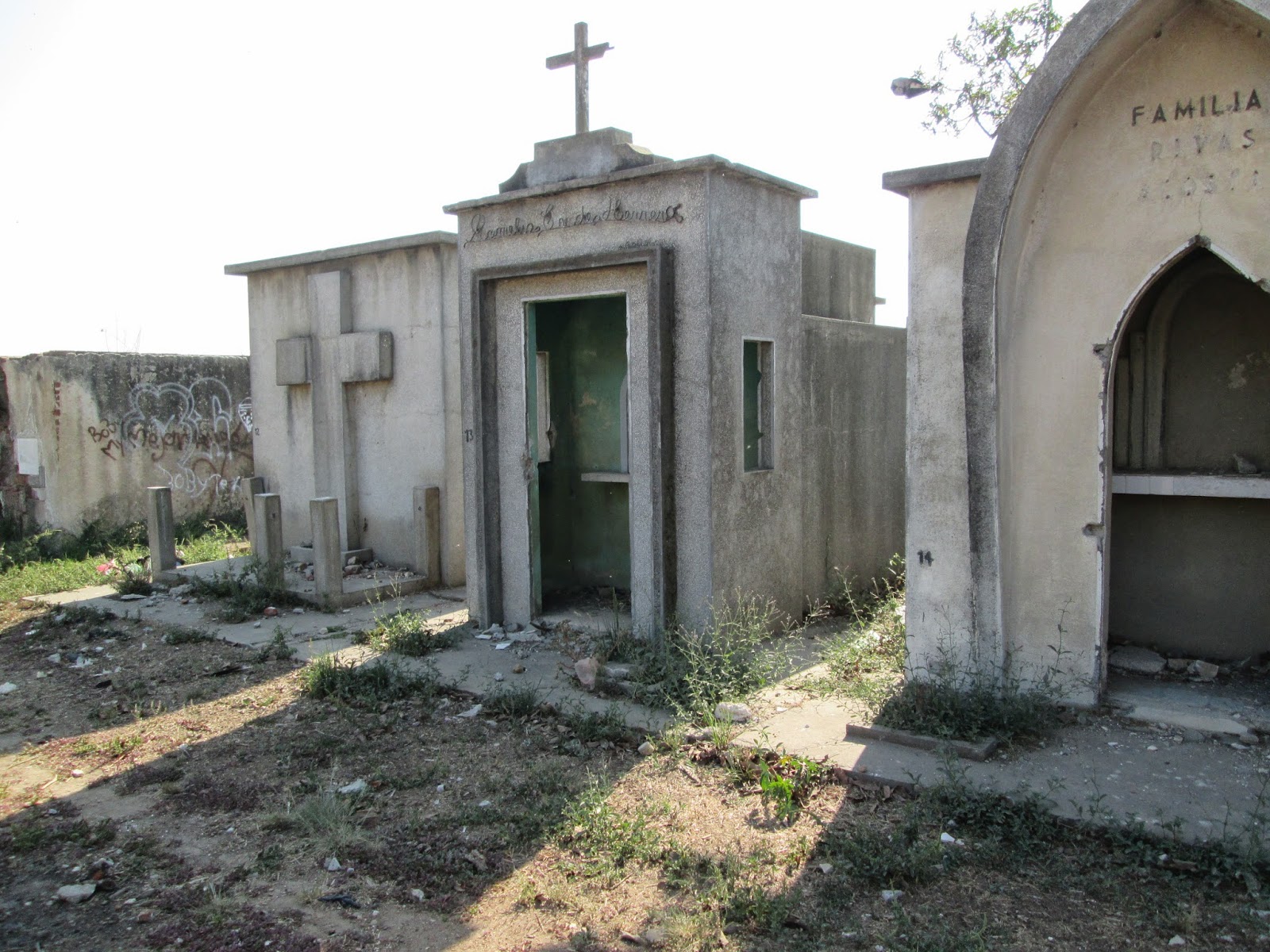
   Before we left Guatemala City, we visited the city dump.  It is located in a ravine just below the city cemetery.  We viewed the dump from the cemetery.  The stench is immediate.  There are many mausoleums in the cemetery and many in disrepair – wide open shelf spaces.  Some are truly grand, built by wealthy families. 

   Below the cemetery in a deep ravine is the city garbage dump.  Garbage trucks run in and out over broken glass.  Children and families search for leftover food and for objects they might use or sell.  The U.N. estimates that roughly 50% of the nation’s children are chronically malnourished – the fourth highest rate in the world.  High overhead vultures circle ready to dive on a quick dinner. I asked a Guatemalan woman about the cemetery.  “My mother is in a mausoleum there; I don’t visit – I don’t feel her presence there.” 

   Yes, though I walk through the valley of the shadow of death, I fear no evil for thou art with me, thy rod and thy staff, they comfort me.  (Psalm 23)
  

                                           Photo by Joan Bleidorn
   
We stopped at a gas station where an entrance was being prepared.  I talked to one of the workers who were loading cinder blocks into a wheelbarrow.  I asked him if he belonged to a union; he said, “no - only skilled workers belonged to unions.”  He may have been mistaken; he probably meant that day laborers had no union and he was a day laborer- his day rate was 75 quetzales, about $10.

   Guatemalan labor opposes the U.S. sponsored neoliberal trade agreement called DR-CAFTA as well as other injustices. Labor has had little influence in Guatemala since the overthrow of the reform government of Jacobo Arbenz in 1954 by the CIA and directed by the Eisenhower administration.

   Since 2007, 64 trade unionists have been murdered.  Luis Antonio Alpirez Guzman secretary of the Health Workers Union said;

   If the bloodshed continues, the entire labor movement will be  irrevocably weakened….it is reminiscent of the chaotic 1980’s and   1990’s era when student and labor activists were murdered on a mass scale…(Chen, Michelle, “Unions Under Siege in Guatemala,” In These Times, 8-24-2013.) 


   The next station I’ll report on was a water project at Chutzoropi in the province of Quiché, a Province so devastated by the military that it was once left by Bishop Gerardi under threat.  The project was sponsored by the Caritas Pastoral Social del Quiche. Gerardi was later murdered by the military in Guatemala City in 1998. A report issued by the Historical Clarification Commission claimed 200,000 people were slaughtered in the 80’s; the Army committed 165 massacres against Mayan Villages. 

   We went into the highlands on unpaved roads and we were grateful for our very skillful Salvadoran driver, Cristobal. We were warmly greeted by the community and sat down to meet each other.  The men introduced themselves. They hung around in little groups along with the boys.   As visitors we introduced ourselves – our names, where we were from, and why we came to visit.  All had to be translated into their indigenous language.  Sister Jan, obviously well known and loved, suggested that the women introduce themselves. The women and girls sat on benches on one side, beautifully dressed in their native costumes - Guipils. With some shyness and through interpreters the women courageously stated their names and something about their family.


                                                                  Photo by Sister Jan Gregorich
   

   Sister Jan asked what the water project meant to them.  They explained in their native language with a couple women speaking in Spanish.  Without the water project they had to go two or three times a day to the river to bring back buckets of water with their children helping. Washing of clothes had to be done at the river. Thirty-three families received water in the immediate area of their homes.  Sanctions were levied for improper use.  Each family paid 10 quetzales, $1.35 per month, to create a fund to be kept in reserve for emergencies. 

   I was not able to discern a ‘communidad autónomo’ as in the Mayan communities just north of Guatemala in Chiapas, Mexico.  The Mayan people at the water project are not completely independent of the government in Guatemala City.

   I commented to Joanne how beautiful these people are – I don’t usually say that anywhere else we travel.  Joanne responded, “They make their own clothes with beautiful colors and wear them humbly without embarrassment. They celebrate who they are.” Joanne talked to a young man who had just returned from Texas for a visit; he planned to return to Texas to make his way in life.  His legal status was not questioned.

   I asked the leader of the project if there was hope for Guatemala; he said, “no!” but then paused and said – “maybe.”  Why maybe?  He said, “…if progressive leaders arise in Guatemala.”  Is this just ‘Waiting for Godot?’

   But for me, this is a reminder of Postville, Iowa in May of 2012.  Federal agents in helicopters and patrol cars swooped into a small Iowa farm town to raid a food processing plant where most of the workers were Guatemalans. Three hundred eighty-nine workers were detained, most of them from Guatemala.  Families were separated – children had no idea what happened to their parents.  Sr. Mary McCauley B.V.M. set up a refuge for the families in the local parish Church – St. Bridget’s. (N.Y. Times, “Postville,” July 11, 2012.)


                                                                    Postville protestor, 2008

   
   A colleague talked to one of the Guatemalan men who lost his family in the ‘80’s during one of the U.S. funded military massacres. The man had obviously not recovered from the devastation of his family.  The three mental health professionals who took the trip with us asked how these people survive the trauma of the genocide of their villages?  I wondered about the re-enacted Holy Week story,… is this pageantry,…therapy?... or both?