Thursday, June 5, 2014

MAYAN SPIRITUAL GUIDES


 Our next stop was visit to a Mayan spiritual guide.  An unusual opportunity was presented.  Would you expect a visit to a spiritual guide of a pagan religion on a tour sponsored by Roman Catholic Religious?  It was an opportunity to compare myths.  Do they compete with each other or are they complimentary?

They raped our mother earth
when they stripped the southern coast
and changed the ecological balance
planting cotton to produce capital
Instead of sacred corn,
which sustains our people.

(Julia Esquivel, “All Guatemala is Rigoberta Menchu,” The Certainty of Spring, Ecumenical Program on Central America, Washington, D.C. 1993)


   We were warmly greeted by the Mayan spiritual leader, his wife and his son at their home and worship center.  There was an open “patio” area, a small room for prayer and reflection and a large room for instruction or discussion.  The large room was equipped with a projector and a large screen.  On display were specially shaped and colored rocks considered sacred.
 
   The video and the talk emphasized the Mayan belief in the oneness of being.  Rituals are held outdoors in the temple of nature itself. For the Mayans all of nature is sacred without distinct differences in value, hence the objection to indiscriminate mining and cash crop agriculture for export.  Mother Earth is sacred.

   Despite the peace accords of 1996 the racist war against the indigenous continues. In 2012 seven campesinos we killed by government security forces.  The indigenous were protesting government policy.   The Mayans ask an important question about their future and the future of the planet: “What will happen if the megaprojects of neo-liberalism succeed?”  (Estudio Sobre el Impacto de los Megaproyectos en  Relaceion a los Lugares Mayas, Santa Cruz del Quiche, 2012)


   The spiritual guide and a colleague were open to discussion.  I asked, if you do not believe that Jesus Christ is God and the savior of all, are you able and willing to collaborate with Christians?  There was dialogue for clarification, and the answer was yes.  The crisis presented by the global neo-liberal policy on mining, energy production, and agriculture has prompted workshops, sponsored by the Mayans, on how to confront the crisis.  Workshops have included leaders from various communities – “Evangelicos, Catholics, teachers, women and young people.” (Ibid)

   Are women permitted to be spiritual leaders?  The answer was yes.  Our spiritual leader’s wife was also a spiritual guide. At a future stop we would pray with a female Mayan spiritual leader at the site of a terrible slaughter of indigenous people in the church and church yard of the Roman Catholic parish – Espiritu Santo.


      From the beginning ‘till now the entire creation, as we know, has been groaning in one act of giving birth; we must be content to hope that we will be saved….           (Romans C. 8,  vs  20 – 25)

Saturday, May 24, 2014

OUR KIDS IN GUATEMALA


      Indian child                                                                                                 
      delicate sprig of violet                                                                                   
      with your breath sustaining                                                                           
      our poor faith                                                                                                                        the sunshine of Justice.  
      From The Certainty of Spring by Julia Esquivel, poet and theologian                                                       
  
   We, the people of the United States, created the situation in Guatemala by financing the 36-year civil war to impose Capitalism - so we own the problems – they’re sealed and paid for.
 

   Holy week is a festival in Guatemala.  The streets are shoulder to shoulder with people – vendors everywhere.  Kids with clever salesmanship sell craft items made by their families.  Some spoke in English, “You buy from me,… maybe tomorrow? Do you promise?”

   I asked a boy what the pageantry was about.  For me, he said, “Holy Week was the time to make a decision.”  “What decision?” I asked.  “Whether to be a Catholic or an Evangelical,” he responded.


  Although I had almost five years of experience in Bolivia and had traveled to many other countries in Latin America, I felt overwhelmed by the meeting with Julia Esquivel, by the discussion at NISGUA and by the trip to the Guatemala City dump.  By the time we reached the village of Santa Apolonia and the Milwaukee School Sisters of St. Francis’ Orphanage, I felt I couldn’t absorb more.  I took no notes; I have memories, but to be accurate and clear as possible, I interviewed Sister Marietta Hanus, S.S.S.F., one of the founders of the orphanage.  Sister Marietta now lives in Milwaukee and is a supporter of the Voces de la Frontera New Sanctuary Movement.


Sister Marietta explained that the story of the orphanage begins in 1981.  Milwaukee School Sisters of Saint Francis had a group of nuns in the municipality of Los Amates de Izabal.  The Milwaukee sisters intended to establish a Guatemala presence of the School Sisters of Saint Francis. S. Marietta did counseling and teaching at the convent.  The sisters also did pastoral work, but they were in the midst of the Guatemalan civil war.  Pastoral work based on “love God and love your neighbor” was subversive.  And then their parish priest was murdered.  The sisters had to leave Los Amates and go into hiding. Some went to Guatemala City, others to Honduras and Mexico. 
  
   The next year the sisters that were refugees in other countries reunited with their displaced sisters in Guatemala City.  A Guatemalan sister noted that the horrible war had destroyed many Guatemalan families, the basis of civil society.  It was decided to establish new homes for mothers widowed by the war and for the orphan children.  It would not be an institution or orphanage as such, so the name chosen was Homes of Our Lady of Guadalupe.  The Bishop of Solola provided land in the village of Santa Apolonia with a 99 year lease.  The buildings were constructed in 1985.


 The first children in the orphanage were from the village of Santa Apolonia and other children displaced by the war were soon added.  War widows were the family caretakers. In the following years the children were to take responsibility for family living and their future.  At ten years old they would decide on which training at the complex they wanted to pursue:   shoe making, sewing and tailoring, carpentry, or farming.  Children could stay until they were 18 years old.  Now there is a government law that the children are to be available for adoption, but the loss of one of the children from a community family can be disrupting.


Sister Marietta told some stories of the children, such as the twins whose mother died in childbirth.  The dad, a local farmer, could not take care of the newborns.  He would come with one of his other children to visit and he brought eggs to the Sisters in gratitude for caring for his sons.  The twins, David and Christopher, prospered at Guadalupe Homes and became competent workers.  One was skilled with computers and the other a mechanic.  

   One boy was the survivor of an automobile accident in which his whole family was killed except for his mom.  She was pregnant with him at the time.  The mom went into a coma, but the baby was born.  She was unable to care for the boy so he was taken in by Guadalupe Homes.  At baptism the baby boy was named Moses because he had been saved by God from death.
   
   Lia, another orphan, was taken into town so she could see a doctor. When she heard marimba music playing on a radio, she became very upset and cried, “That was the music I heard when they killed daddy.”   When soldiers appeared at the community gates she pleaded, “You’re not going to kill us like you did my daddy.”

   What about the soldiers?... they too are just kids recruited from the countryside.  During the Holy Week pageantry they were very visible on the streets.  I asked one very young soldier, armed with an automatic weapon, if it was true that in the past the military massacred people in various municipalities.  He said, “Yes.”  I asked if he also would do that – he said, “I don’t know.” 

When they reached the place called the Skull,                                                   they crucified him and the criminals there,                                                          one on his right, the other on his left.                                                                Then Jesus said, “Father forgive them                                                                for they know not what they do.”

(Luke 23, 33-34)   


Sunday, May 11, 2014

A RENOVATION OF FAITH, continued


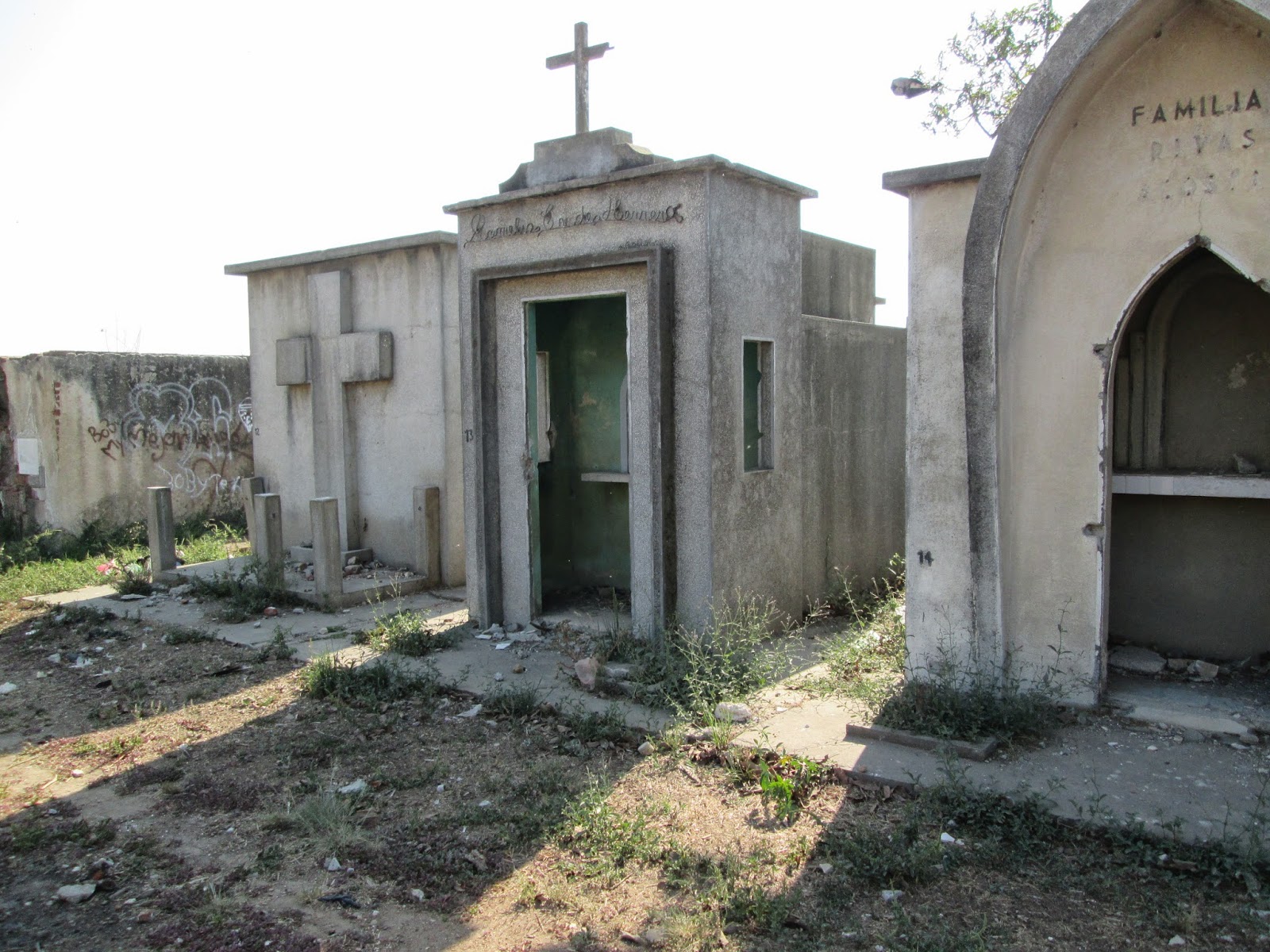
   Before we left Guatemala City, we visited the city dump.  It is located in a ravine just below the city cemetery.  We viewed the dump from the cemetery.  The stench is immediate.  There are many mausoleums in the cemetery and many in disrepair – wide open shelf spaces.  Some are truly grand, built by wealthy families. 

   Below the cemetery in a deep ravine is the city garbage dump.  Garbage trucks run in and out over broken glass.  Children and families search for leftover food and for objects they might use or sell.  The U.N. estimates that roughly 50% of the nation’s children are chronically malnourished – the fourth highest rate in the world.  High overhead vultures circle ready to dive on a quick dinner. I asked a Guatemalan woman about the cemetery.  “My mother is in a mausoleum there; I don’t visit – I don’t feel her presence there.” 

   Yes, though I walk through the valley of the shadow of death, I fear no evil for thou art with me, thy rod and thy staff, they comfort me.  (Psalm 23)
  

                                           Photo by Joan Bleidorn
   
We stopped at a gas station where an entrance was being prepared.  I talked to one of the workers who were loading cinder blocks into a wheelbarrow.  I asked him if he belonged to a union; he said, “no - only skilled workers belonged to unions.”  He may have been mistaken; he probably meant that day laborers had no union and he was a day laborer- his day rate was 75 quetzales, about $10.

   Guatemalan labor opposes the U.S. sponsored neoliberal trade agreement called DR-CAFTA as well as other injustices. Labor has had little influence in Guatemala since the overthrow of the reform government of Jacobo Arbenz in 1954 by the CIA and directed by the Eisenhower administration.

   Since 2007, 64 trade unionists have been murdered.  Luis Antonio Alpirez Guzman secretary of the Health Workers Union said;

   If the bloodshed continues, the entire labor movement will be  irrevocably weakened….it is reminiscent of the chaotic 1980’s and   1990’s era when student and labor activists were murdered on a mass scale…(Chen, Michelle, “Unions Under Siege in Guatemala,” In These Times, 8-24-2013.) 


   The next station I’ll report on was a water project at Chutzoropi in the province of Quiché, a Province so devastated by the military that it was once left by Bishop Gerardi under threat.  The project was sponsored by the Caritas Pastoral Social del Quiche. Gerardi was later murdered by the military in Guatemala City in 1998. A report issued by the Historical Clarification Commission claimed 200,000 people were slaughtered in the 80’s; the Army committed 165 massacres against Mayan Villages. 

   We went into the highlands on unpaved roads and we were grateful for our very skillful Salvadoran driver, Cristobal. We were warmly greeted by the community and sat down to meet each other.  The men introduced themselves. They hung around in little groups along with the boys.   As visitors we introduced ourselves – our names, where we were from, and why we came to visit.  All had to be translated into their indigenous language.  Sister Jan, obviously well known and loved, suggested that the women introduce themselves. The women and girls sat on benches on one side, beautifully dressed in their native costumes - Guipils. With some shyness and through interpreters the women courageously stated their names and something about their family.


                                                                  Photo by Sister Jan Gregorich
   

   Sister Jan asked what the water project meant to them.  They explained in their native language with a couple women speaking in Spanish.  Without the water project they had to go two or three times a day to the river to bring back buckets of water with their children helping. Washing of clothes had to be done at the river. Thirty-three families received water in the immediate area of their homes.  Sanctions were levied for improper use.  Each family paid 10 quetzales, $1.35 per month, to create a fund to be kept in reserve for emergencies. 

   I was not able to discern a ‘communidad autónomo’ as in the Mayan communities just north of Guatemala in Chiapas, Mexico.  The Mayan people at the water project are not completely independent of the government in Guatemala City.

   I commented to Joanne how beautiful these people are – I don’t usually say that anywhere else we travel.  Joanne responded, “They make their own clothes with beautiful colors and wear them humbly without embarrassment. They celebrate who they are.” Joanne talked to a young man who had just returned from Texas for a visit; he planned to return to Texas to make his way in life.  His legal status was not questioned.

   I asked the leader of the project if there was hope for Guatemala; he said, “no!” but then paused and said – “maybe.”  Why maybe?  He said, “…if progressive leaders arise in Guatemala.”  Is this just ‘Waiting for Godot?’

   But for me, this is a reminder of Postville, Iowa in May of 2012.  Federal agents in helicopters and patrol cars swooped into a small Iowa farm town to raid a food processing plant where most of the workers were Guatemalans. Three hundred eighty-nine workers were detained, most of them from Guatemala.  Families were separated – children had no idea what happened to their parents.  Sr. Mary McCauley B.V.M. set up a refuge for the families in the local parish Church – St. Bridget’s. (N.Y. Times, “Postville,” July 11, 2012.)


                                                                    Postville protestor, 2008

   
   A colleague talked to one of the Guatemalan men who lost his family in the ‘80’s during one of the U.S. funded military massacres. The man had obviously not recovered from the devastation of his family.  The three mental health professionals who took the trip with us asked how these people survive the trauma of the genocide of their villages?  I wondered about the re-enacted Holy Week story,… is this pageantry,…therapy?... or both?

Thursday, April 24, 2014

PILGRIMAGE IN GUATEMALA – A RENOVATION OF FAITH

            My wife Joanne and a mutual friend from our parish and another couple from Milwaukee all went to Guatemala with the GATE program (GLOBAL AWARENESS THROUGH EXPERIENCE) for a ten day Holy Week pilgrimage.  We were joined on the trip by three mental health therapists from Ohio.  The group was skillfully shepherded by two nuns, one from the GATE project and the other a Milwaukee - Notre Dame Sister with many years of experience in Guatemala.


   Joanne and I had a sense of what we might experience because we both had read Francisco Goldman’s book, The Art of Political Murder.  The book is a detailed account of the murder of Bishop Juan Gerardi in 1998 by the Guatemalan military. 

   I would like to recount eight stations out of over ten from our pilgrimage:

  •    visits with Guatemalan poet Julia Esquivel;
  •    an interview with the staff of NGO’s, ACOGUATE & NISGUA;
  •  the Guatemala City Cemetery and garbage dump;
  •  a discussion with Guatemalan worker
  •    a meeting with an indigenous community that developed a water project;
  • a visit to an orphanage in Santa Apolonia
  •    a meeting with a Mayan spiritual leader;  
  •  a visit to Holy Spirit Church - the site of one of the massacres of the  indigenous people by the Guatemalan Military;
  •    discussions and visits to various projects at St. Lucas Toliman
  •  Santiago de Atitlan;
  •    Holy Week in the old capital city, Antigua.  

Comments by Guatemalan people will be added.

Each posting will recount the experience of one or two events. 

   This first posting will describe our meetings with Guatemalan poet and theologian Julia Esquivel and our visit to the office of an N.G.O. from the U.S. called NISGUA.

Ist Station:  JULIA ESQUIVEL, GUATEMALAN POET - THEOLOGIAN

   So be it.  Welcome, O life! I go to encounter for the millionth time the reality of my experience and to forge in the smithy of my soul the uncreated conscience of my race. 
(James Joyce, Portrait of an Artist as a Young Man)

   I came to the discussion with the following questions: does the myth of the passion and resurrection overcome the myth of capitalism; does the myth of the passion and resurrection provide healing, forgiveness and hope in confronting capitalism or does it simply support capitalism?  Julia Esquivel provided comfort and cogent responses.

  In Guatemala the questions are not academic; we would be in denial if we dismissed these questions for another time.  In 1996 U.N. monitored peace accords were signed and, as a result, reduced the military intensity of civil war that had been raging for 36 years.  Thousands of indigenous people were slaughtered during the civil war, financed by the Reagan administration, with the purpose of defending capitalism against a communist takeover.  


The following is a comment on the peace accords published by an official Mayan Council:

The territory in the neo – liberal epoch

   After an epoch of living terror in the territory of Guatemala, in December of 1996 a peace agreement was signed between representatives of the government, the army and representatives of the guerilla.  In reality this peace deemed firm and permanent is no more than a false peace and is used for the development of only a few people. (Consejo Maya Chilam B’alam de los Kiches, Estudio Juridico de los Lugares Sagrados: Xetinimit, Mamaj, Talkuch, Awilix, Q’abitzad, ToJil, Mecanismo de Apoyo a los Pueblos Indigenas Oxlajuj Tz’kin, 2012, p.P.31)


   Julia Esquival, who spent several years in exile during the war, said there was no hope in the government, but hope lies in the faith of the people – the communities.  For example, they are resisting environmentally harmful mining projects where women are lying in the road in front of mining trucks.  She asked us to imagine the courage it took for indigenous people to testify at the genocide trial of General Rios Montt.  Julia indicated that sadness prevails and too much emphasis in the Holy Week rites is placed on the Passion and not enough on the Resurrection. She wrote in her published book of poetry, Threatened with Resurrection:

   RESURRECTION                   ON THE MARCH
I am in love with life,                                     Titanic task
The sun, the howling of ,                                 a divine task, ours:
    mountain winds                                          to make ourselves human!
The storm, the clap of thunder,                        Sole possibility    
The songbird’s joyful singing,                         to live with meaning,      
The rabbit’s delight,                                       to know Life     
The barking dogs,                                           to fuse with her intimately,     
And the promenade of the snails                              Illuminated! 
After the rain.                                                     


AND WHAT DO THE PEOPLE SAY ABOUT HOLY WEEK in Guatemala?

A middle aged woman in traditional garb serving as a waitress in the Pan American Hotel in Guatemala City shared the following:

   For some it’s fun and pageantry, I am a Christian, for me it is a time to remember Jesus’ death and resurrection.

A nun sitting on the steps of the Cathedral in Guatemala City selling religious CD’s:

   It’s about who we are, where we've been, and where we are going. The crucifixion and the resurrection go together as the same event.   

2nd Station:  ACOGUATE and NISGUA  (Network in Solidarity with the People of Guatemala - based in the U.S.)

   Two young workers, my guess under 30, explained their accompaniment duties.  ACOGUATE and NISGUA workers accompany Guatemalans who are under threat because of their social activism.  They provide an international presence.  An example would be the indigenous people testifying at the Rios Montt genocide trial.  I noted that it is not just Guatemala that is suffering a threatened existence; this is happening worldwide.  

   I asked, what is the cause?  The response, without hesitation, from the young woman from Juneau, WI was – racism.


Thursday, March 27, 2014

Pope Francis’ ‘Joy of the Gospel’ (Proclaimed November 24, 2013)

  The ‘Joy of the Gospel’, Evangelii Gaudium, brings to the whole world the good news - the Gospel.  Pope Francis proclaims the basic message that God loves all of creation, even sinners, and that the Kingdom of God is here on earth in so far as we love God and neighbor.  He cites the message of previous popes of ‘preferential option for the poor.’   In Pope Francis’ personal invitation to the faithful to work for social justice, love of neighbor, he does not use the ‘imperial we’ as did previous popes in similar messages. Paul VI wrote on the same subject in 1975, ‘On Evangelization in the Modern World’ (Evangelii Nuntiandi), and used the ‘imperial we.’  Pope Francis is by definition a monarch, but he has chosen to be a benevolent dictator and hears the cry of the people.

      Evangelii Gaudium boldly explains that Faith is confidence and trust in the God of Abraham, Isaac and Jacob creator of all - a God that works with people to overcome the evil of an individualistic ‘survival of the fittest’ economic doctrine.  With Jesuit clarity, Pope Francis contrasts the Faith of Jews, Christians and Muslims in the one true God with faith in the ‘invisible hand’ that is supposed to regulate the market place.  Francis states:

   …some people continue to defend the trickle-down theories which   assume that economic growth encouraged by a free market, will   inevitably succeed in bringing about greater justice in the world. This opinion, which has never been confirmed by the facts, expresses a crude and naïve trust in the goodness of those wielding economic power and in the sacralized workings of the economic system. #54


   As pastor of a church without frontiers, Francis pleads for migrants:

I exhort all countries to a generous openness which, rather than fearing the loss of identity, will prove capable of forming a new form of cultural synthesis. #210

In solidarity with the faithful and the poor Francis laments:

I have always been distressed at the lot of those who are victims of various kinds of human trafficking. How I wish all of us would hear God’s cry “Where is your brother?” (Gn. 4:9) Where is the brother and sister whom you are killing each day in clandestine warehouses, in rings of prostitution, in children used for begging, in exploiting undocumented labor?   #210  
              
With regard to his own flock, Francis directs with authority:     
  
We Christians should embrace with affection and respect Muslim Immigrants to our to our countries … #253
  
   In the ‘Joy of the Gospel’ Francis, the first American pope, prays with Faith to Mary, the patroness of the Americas, hoping that his invitation to a new evangelization will be accepted by the faithful.  Francis reminds all of us the story that the campesino and evangelizer, Juan Diego, was comforted and strengthened by Our Lady of Guadalupe.  #286


Thursday, March 13, 2014

OFFICIAL CHURCH DOCUMENTS: CATHOLIC SOCIAL TEACHING


INTRODUCTION

shema yisra’el Adonai ’elohenu Adonai ’ehad.  Duet. 6:4                                                           Hear, O Israel, Adonai is our God, Adonai is one.

   An opinion: elohenu is the God of nature, the philosophers – e.g.  Aristotle’s uncaused cause, Stephen Hawking’s big bang and final crunch.  elohenu  retaliates with anger and requires sacrifice.

   Adonai reveals a presence; Adonai is the Father – Mother of all; Abba of Abraham, Isaac, Jacob and the prophets.  Adonai supports the struggle for justice; he advocates and acts for the poor. Adonai is truly only one.

     The model, the documents and comments listed are based on notes taken at a seminar in the summer of 2003 given by Dr. Christine Firer Hinze of Fordham University, formerly of Marquette University and recognized expert on the work of labor priest, John Ryan.  (1865-1945)   The seminar was one of many graciously given by Dr. Hinze for interns and other labor associates of the Faith Community for Worker Justice in Milwaukee.  Dr. Hinze also participated in the annual ‘Labor in the Pulpits Program.’  The New Sanctuary Movement of Voces de la Frontera now sponsors the same program, ‘Predicators de Justicia’ for the May 1st Labor Day since the Faith Community for Worker Justice of the Milwaukee Labor Council folded.

   Some additions and deletions were made to Dr. Hinze’s notes.  As the discussion continues, more changes will be made.  Notable points are listed, but it is recognized that such abbreviations do not really represent the richness and complexity of the Encyclicals. October, 2011, revised  March, 2014.


 EARLY DOCUMENTS  

Rerum Novarum, 1891, Pope Leo XIII:  Workers’ right to organize. #36

Program for Social Reconstruction, 1919, U.S. Bishops:  Value international & interdenominational cooperation- also, equal pay for equal work for women, right to a living wage including health care.

Quadragesimo Anno, 1931, Pope Pius XI: Principle of subsidiarity. #80


TRANSITION PERIOD

Social Documents, 194I –1952, of Pope Pius XII. 

 Whitsuntide Message, 1941: Pvt. property has social responsibilities.

 Xmas Message,  Democracy & Peace, 1943:  “Corporate” democracy OK.  Distrust of “masses.”                                                                                                                                                                                                                                                                
To the Representatives of the International Union of Catholic Employers  Associations, 1949: Reaffirm Q.A. Nationalization of assets, with limits, to protect common good.                                                                                              
To the International Congress of Social Studies, 1950: Balance of production withconsumption a key issue - free mkt. not the answer.  Workers ancient feudal bonds similar to modern wage slavery.

To the Italian Catholic Association of - Owner Managers, 1952: Principle of Solidarity.                                        
Letter to 39th “Social Week” Dijon, France, 1952:  Free market does not produce distributive justice.                                                                                                                                                                                                                         
Radio Address to Austrian Catholics, 1952: Overcome class struggle by organic coordination of employer & employee.

Exul Familia, 1952: Right to migrate.

Xmas Message, 1952: Unrestricted production is not the answer to unemployment.  Advocates international solidarity.

Letter of Mons. Montini (future Pope Paul V I) to Catholic Social Week in Turin, Italy, 1952: Addresses worker alienation.  Advocates worker, employer solidarity.                                                                                     
Mater et Magistra, 1961, Pope John XXIII: Social duty of private property, Cf. Pius XII. Part 1, 41-43.  Values collective bargaining.  Part 2, 91.                                                                                                                                                                                                                                                    
Pacem in Terris, 1963, Pope John XXIII: Dignity of the person is the basis of human rights & duties.  The first Encyclical directed to all men in hope of peace through justice,  part 1, B.  Right to migrate confirmed, part 1, 25.  Right to medical care, Part 1, 11.    


DRAMATIC CHANGE   “AGGIORNAMIENTO”                            VATICAN II CRITICAL, YET OPEN TO THE IDEAS OF THE MODERN WORLD  
                                                                                                                         
1962 – 1965         Council Fathers with Pope Paul VI

Unitatis Redintegratio. (On Ecumenism),1964: Advocates cooperation with                                   “separated brethren”  on social issues. C. II,12

Lumen Gentium, (Dogmatic Constitution on the Church),1964: The Spirit dwells                           in the people. C. I, 4.   
                                                                                                    
Gaudium et Spes, (Pastoral Constitution on the Church),1965:  Labor right. to organize               organize & freely elect leaders.  Right  to strike. (vs. fascist Spain & Franco) #68                                                                                                       
Dignitatis Humanae, (Freedom of Conscience) 1965: In all activity man is bound to follow his own conscience. #3  
                                                                                                                      
Nostra Aetate, (Relation to Non Christians),1965:  Although hostilities in past - make    common cause for social justice. #2

Dei Verbum, (Dogmatic Constitution on Devine Revelation), 1965:  God can be known by all through reason.  #1.


POST VATICAN II

Populorum Progressio, (On the Development of Peoples),1967, Paul VI: Neo-colonialism  a concern.   Free trade is fair only if it is subject to the demands of  social justice. Part II, 52–58.                                               
Medellin, Colombia Documents, 1968, Latin American Bishops: Foundation of Liberation Theology – Political and economic structural change advocated.                                                                                              
Octogesimo Adveniens, (Eightieth Anniversary of Rerum Novarum, 1971, Paul VI:                 Women have equal rights to participate in cultural, economic and political life.  #13
Puebla, Mexico Documents, 1979, Latin American Bishops: Visiting Pope J.P. II endorses Liberation Theology.

 Laborem  Exercens, (On Work),1981, John Paul II: Proper subject of “work” – man #5 & #6. Solidarity of workers  #8. Labor is prior to capital #12.  Labor Unions indispensable  #20 
                                                                                                            
Economic Justice for All, 1986, U.S.  R.C. Bishops: Use of sociological data.                                                                              
Solicitudo Rei Socialis,  (On Social Concern). 1987, John Paul II: In Solidarity, overcome structures of sin for true liberation. VII, 46

Centesimus Annus, (One hundredth Anniversary of  Rerum Novarum),1991, John Paul II:  The church values the democratic system in so far as it insures the participation of citizens in making political choices.  Chapter 5, #46.  Roman Catholic Social Teaching pertains to the church’s evangelizing mission and is an essential part of the Christian message…’ C.I, 5.

Strangers No Longer: Together on the Journey of Hope, 2003, U.S. and Mexican Bishops.  Persons have the right to migrate to find work and support themselves and their families.

Caritas in Veritate, (Selfless Love in Truth), 2009, Benedict XVI: Trade union organizations  experience greater difficulty in carrying out their task of representing the interests of workers, partly because Governments, for reasons of economic  utility, often limit the freedom or the negotiating power  of labour unions.  Hence traditional networks of solidarity have more and more obstacles to overcome. Section 25.                                                                                                                              
Towards Reforming the International Financial and Monetary System in Context of Global Public Authority. 2011, Pontifical Council of Justice and Peace, Rome.  
Creation of world public authority to regulate financial markets that  “cause inequities and distortion of capitalist development.”


Evangelii Gaudium, Pope Francis, November 24, 2013.  “In this context, some people continue to defend the trickle – down theories which assume that economic growth, encouraged by the free market, will inevitably succeed in bringing about greater justice and inclusiveness in the world.  This opinion, which has never been confirmed by the facts, expresses a crude and naïve trust in the goodness of those wielding economic power and in the sacralized workings of the economic system.” C.II, 54