Tuesday, January 24, 2023

MLK, Chenu & Aquinas on Non-Dualism and Body Politic


January 23, 2023 Daily Meditation by Rev. Dr. Matthew Fox


Friday, January 20, 2023

Dr. Martin Luther King’s Vision Applied to the Wars and Militarism of 2023 By Jim Carpenter


On Dr. Martin Luther King Jr. Day, we commemorate his vision and victory for civil rights but we often neglect his vision for economic justice and an end to war. On January 16, 2023, a broad coalition of groups in Milwaukee came together to commemorate his vision for ending war and militarism.

This is the story of that event starting with coverage by local TV.

https://www.cbs58.com/news/leaders-activists-gather-around-milwaukee-mlk-statue-to-remember-dr-king


And here is the speech I gave at the event.

Hello friends:

Thank you for tolerating the cold and rain in order to honor the great Rev. Dr. Martin Luther King Jr.

My name is Jim Carpenter and I am a retired economics instructor and peace activist.  

Every time I hear the words of Dr. King I realize what a visionary and deeply spiritual person he was. I am very pleased that this coalition speaks about all of the visions of Dr. King, not only his vision for racial justice but also his vision for economic justice and an end to war.

I was asked to say a few words about the cost of military spending and war. Often people address this topic by focusing on our obscenely large military budget and then asking what would be a better use of this money. This is important because our military budget is so obscenely large and wasteful and our unmet human needs are so great.

To put this in perspective, I will quote a few sentences from the most profound Congressional Resolution on this issue that I have ever read, H. Res. 476, ‘Expressing the Sense of the House of Representatives regarding wasteful Pentagon spending and supporting cuts to the bloated defense budget”. This was introduced by Congresswoman Barbara Lee in 2021.  

I quote:  

The United States has spent and obligated an estimated $6.4 billion on military operations since September 11, 2001, and has been at war constantly since then; 

The United States could save an estimated $350 billion per year by cutting defense spending on our endless wars and by cutting unnecessary and wasteful defense spending and would still be spending more on the military than China, Russia, Iran, and North Korea combined;

Sadly, this resolution never came close to passing because the majority of both parties are pawns of the Military Industrial Complex that President Eisenhower warned of. 

To put $350 billion in perspective, I calculated that Milwaukee County's share of $350 billion based on the population of our county equals $1.1 billion. abpit 80% of the County budget.this money could go a long way towards providing affordable public housing for the unhoused, replacing our lead pipes and transitioning to a green economy.

However, we make a big mistake if we only focus on the waste in the military budget.

The real cost of war is not the military budget; it is the death and destruction that weapons are used for.  Dr. King's words spoke of this cost.

"It is no longer a choice, my friends, between violence and nonviolence.  It is either nonviolence or nonexistence."

I ask you, what price do you put on existence?  Obviously, it is priceless.  Yet, the current escalation of the Ukraine War is risking moving us onto what Dr. King called the "militaristic stairway into the hell of nuclear annihilation."  

We are being asked to make an insane bet.  We are being asked to give Ukraine enough weapons to achieve a total military victory over Russia, taking all the territory Russia has gained not only since last February but also all the territory gained since 2014, including Crimea.  We are asked to make the bet that Russia will not use all the weapons in its arsenal, including nuclear weapons, to prevent this total defeat.  We may win this bet.  But what if we don't? What if Russia does all it is capable of doing to prevent this total defeat?  Are we prepared to risk the destruction of humanity in a fight over Crimea?  That's insane.  

There is no sane military solution to this war.  I repeat, there is no sane military solution to this war.  Even if it does not go nuclear, a long, protracted war with hundreds of thousands more killed is insane.

The only sane solution is a mutual ceasefire and negotiations for a permanent peace.  

A ceasefire and negotiations do not mean appeasement.  Dr. King was very clear.  The struggle for justice can occur without the use of violence.  He won the battle for civil rights using nonviolence. Justice in Ukraine must be obtained without more war.  Dr. King said, "If we assume that mankind has a right to survive then we must find an alternative to war and destruction."


To learn more about this issue and how you can get involved go to: 

www.peaceinukraine.org

www.codepink.org

www.worldbeyondwar.org

Call your Representative and Senators at 202-224-3121.  Ask them to stop escalating the war with more weapons and instead push for a mutual ceasefire and negotiations for a permanent peace.

About the author:  Jim Carpenter is a lifelong peace activist and was a conscientious objector during the Vietnam War.  He is currently Co-chair of the End Wars and Occupations (Foreign Policy) Issue Team at Progressive Democrats of America.  He is recently retired from Milwaukee Area Technical College where he taught Ecological Economics, a branch of economic that recognize the limits to economic growth on a finite planet.  He can be reached at jcmilwgr@yahoo.com.

Tuesday, January 17, 2023

RELIGION AND FAITH IN POLITICS

President Biden preaching at Martin Luther King’s church

in Atlanta seems hypocritical.  Reverend King was

opposed to war.  He suffered negative criticism for his

stance on the war in Vietnam.


Biden’s massive support for Ukraine ignores Rev. King’s

opposition to war.


What is the role of religion/faith in the politics of war and

liberalism?


Friday, January 13, 2023

The Working Catholic: Charity by Bill Droel


“To give away money is an easy matter… But to decide to whom to give and how much and when, and for what purpose and how, is neither in every [person’s] power nor an easy matter.” –Aristotle (384 BC-322 BC)

 The hard part of giving away wealth “is figuring out how to do it in a leveraged way. It is not easy. Building Amazon was not easy… And I am finding that philanthropy is very similar. It’s not easy.” –Jeff Bezos

My friend (who is not in Bezos’ wealth bracket) thinks about the effectiveness of his charity. His current policy is to daily put about $5 in his car’s cup holder. He dispenses it to the first beggar on his route; maybe splitting the donation if there are two beggars on the corner. Another friend refuses to give handouts on the street. He generously sends annual checks to agencies that assist the needy.Clarity about thoughtful giving avoids comparisons with the wealthy. This means giving up “certain myths” surrounding philanthropy, writes Anand Giridharadas in N.Y. Times (11/21/22). These myths are part of a template that distorts how we think about charity and how some non-profit organizations structure their fundraising and their service.

These celebrities are often a cause of the very problems their donations claim to ameliorate and they present a faulty model of charity which others imitate, Giridharadas charges. They made their money with “dehumanizing labor practices… tax avoidance [and] influence peddling.” In return for a donation they get “labor, tax, antitrust and regulatory policies” that benefit acquisition of more wealth. In addition they get their names on buildings, invitations to galas and favorable press coverage. Until that is, their house of cards falls down like a Sam Bankman-Fried crypto exchange.  

Keep in mind too that despite their press coverage the wealthy give the least relative to their wealth. The poor give the most. (See Luke 21:1-4)
For some celebrities the publicity around their charity is their only goal, writes Peggy Noonan in Wall St. Journal (12/4/22). They have a deep need for admiration or status; they need to be regarded as moral or altruistic. Donors of this type, despite their language, are oblivious to the outcomes of their charity.

Noonan points to the necessity of an informed conscience, without which one’s behavior, including charitable giving, is a fraud. “A conscience has to be formed and developed,” she explains. It is not given at birth. It is not one’s opinions or feelings.  

Aristotle says that a conscience is a product of virtue and that virtues are honed through reflection and noble behavior.
Reflection means attending plays, reading novels and studying biographies and then thinking about how one’s own life is like or unlike that of the characters. Is my character flaw similar to Richard Nixon’s? Why did Iago plant doubts about Desdemona? Is it really jealousy?
Noble behavior means repeatedly exercising courtesy, simple acts of beneficence and small steps for justice. In time reflection and habit inform a person’s conscience.

As for so-called effective charity, my two friends, people of virtue, need not get twisted over how to donate in a leveraged way. Avoid giving to organizations that are administrative-heavy. Avoid non-profits that use abstract words like “empower,” “entrepreneurial women,” “new paradigm” and the like. Look for non-profits that directly deal with problems and that pound away without headlines; non-profits like private high schools whose students come from struggling families, like small groups that assist young mothers, those that care for the intellectually disabled, or that welcome refugee families, or that distribute groceries to the needy every Wednesday morning, or that faithfully provide disaster relief. The range of good causes is wide. The legitimate agencies are many.

Whether Schedule A is part of one’s tax filing or not, these are appropriate days to review one’s charity. Is the total close to 20%? Is it more or less than in 2021? What is one’s goal for 2023? How much? To whom? When? In what form? To honestly deal with these questions and act on one’s answers is a process of grace.

Droel edits a newsletter on faith and work, INITIATIVES (PO Box 291102, Chicago, IL 60629).

Monday, December 26, 2022

Democracy by Bill Droel


Democracy requires a thick, independent civil society. Democracy is a fraud when restrictions are placed on churches, when unions are really fronts for the government or the company, when self-supporting newspapers and other media succumb to mega-forces and when there is only one viable political party. It is likewise difficult to impose genuine democracy in a place that does not traditionally have networks of autonomous groups.

The benefits of civil society are multiple. It is through participation in middle-range groups that citizens practice the arts of public life. Further, individuals buffered by civic groups do not have to come directly up against bureaucratic forces like a cable TV provider, a health insurance company or a large government agency.

A small group fulfills two needs--the need to belong and the need to make a difference. Now, some groups are mostly about belonging. And, some groups are almost entirely focused on external action. But the healthy group addresses both conviviality and mission, even if one or the other element is but a pinch of the group’s activity. A healthy group welcomes each member and misses them when they are gone. A healthy group gives each member an opportunity to accomplish something in the world that they could not do on their own.

Democracy flourishes when an individual belongs to three or six or twelve different groups. As members circulate, they bring the needs or interests of one group to the attention of another. And the multiplicity of groups diffuses any dangerous passion that arises when one group dominates.

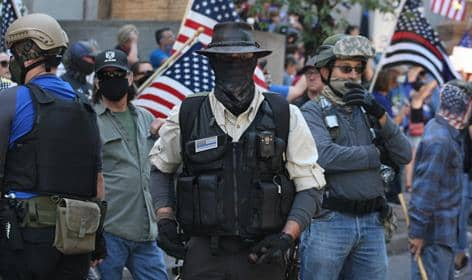
In that regard it must be quickly noted that a genuine small group aims toward the common good. The Boogaloo Boys and the Proud Boys do not qualify as part of civil society.

                                                          Boogaloo boys

Democracy is a main achievement of modernity. But modernity is accompanied with dissatisfactions born of the emphasis on individual liberty. Emile Durkheim (1858-1917), to mention an example, seeing the downside of excessive liberty, founded the discipline of sociology. Its concern is the loss of community in our modern society. Extreme autonomy, as it turns out, makes for ragged individuals.

                                                                    Robert Putnam


By several measures alienation is getting worse. Harvard University professor Robert Putnam tracks participation in civic groups from the 1890s through today. His books, including Bowling Alone (2000) and Our Kids (2015), approach the topic from multiple angles. He finds a precipitous decline in the number of people who belong to all manner of groups and a decline in the hours they devote to such groups. Proceed with caution if you dispute Putnam’s analysis because he has crunched every statistic imaginable.


Why the decline? It is not because of common assumptions like more women in the workplace. In fact, Putnam finds, employed women are more likely than others to belong to school boards, church committees and the like. There is, he discovers, a strong inverse relation between hours spent in front of a screen and hours devoted to civic groups.

The loss of strong mediating groups and thus the precariousness of democracy is not so much about politics as it is culture. Zygmunt Bauman (1925-2017) calls ours a liquid culture. It adapts its shape, its so-called values and its institutions to circumstances and trends. Our culture is quick to propose short-term remedies to malaise. Among the false resolutions of our unease are celebrity gossip, excessive consumer choices, one-off relationships, New Age fads, negative protest movements and short-lived attempts to turn back the clock.

A sense of community cannot be restored all-at-once by a solitary individual. But glue can be applied two-by-two. The tool is relational appointments that gradually form a culture of encounter. It is tempting to think that if people would just talk to neighbors, porch to porch that community would occur. But the remedy, though it feels strange at first, is at once new and old. The solution is like an art form; sitting with another for a half hour or 50 minutes, reverently listening to the other’s interests. Then, in time, a relational person introduces the interests of one public friend to another.

It is happening among a small number of leaders who are tired of narrowly-focused electoral campaigns and are experimenting with deep canvassing. With awkwardness they make appointments in a precinct only to listen and then to share part of their own story—five, eight or maybe more appointments a week. There are church members who do something similar, meeting with members of those in other denominations. There are some young union activists who go beyond standard spiels about wages and meet for a listening session with consumers, stakeholders and non-union members.  

Democracy will survive and thrive to the extent that people turn off their TV and mobile device and exercise some calculated vulnerability in relational encounters, week after week.


Droel edits INITIATIVES (PO Box 291102, Chicago, IL 60729), a newsletter on faith and work.

Wednesday, December 7, 2022

A Christmas Theme by Bill Droel


Remember always to welcome strangers, for by doing this some people have entertained angels without knowing it. (Hebrews 13:2)


Nativity 

Welcoming strangers is a Christmas theme. It appears in a half verse in the story of Jesus’ birth: Upon arriving in Bethlehem, Joseph and Mary learned “there was no room for them at the inn.” (Luke 2:7) The Mexican Posada tradition creatively dramatizes the incident. But the facts are scant. After all, what did the Holy Family expect showing up without reservations on a busy holiday weekend? Smile.


Let’s admit that a country with completely open borders is a contradiction in terms. And let’s acknowledge that immigrants and refugees present problems to a country that admits them. Yet in the United States, as in many other countries, prosperity utterly depends on an orderly influx of immigrants. At the moment, nearly all agree, our country’s immigration policies are not adequate for what is happening domestically and internationally.


Utica, New York is situated on the Mohawk River and the Erie Canal, just off the New York Thruway. For eight years Susan Hartman researched Utica to write City of Refugees: the Story of Three Newcomers Who Breathed Life into a Dying American Town (Beacon Press, 2022).

Beginning in the mid-1800s Utica became an industrial hub for textile mills, lumber mills and factories. Its residents were Italian-Americans, German-Americans, Polish-Americans and Irish-Americans. In the late 1800s Lebanese-Americans and Syrian-Americans settled in Utica. They staffed or owned dry goods stores and groceries. During the late 1940s the textile industry began to move away, but General Electric and other manufacturers came to Utica. Then in the early 1990s, GE and other employers like Univac and the U.S. Air Force left the Utica area.  


Supporting immigrants at Voces de la Frontera

Hartman doesn’t dwell on who left town, but on who arrived. In the 1980s it was Vietnamese-Americans. Local clergy, school officials, administrators at Lutheran Services and Syracuse Catholic Charities founded the Mohawk Valley Resource Center (www.thecenterutica.org) to assist those from war-torn Vietnam. That ethnic group is now fully integrated in Utica’s economy and society. During the 1980s, The Center and Utica’s leaders likewise greeted immigrants from Laos, Poland and the then Soviet Union. The children of those groups now staff and own furniture stores and car dealerships plus are employed in health care, education and service settings. In the 1990s Utica experienced a wave of immigrants from Bosnia. They are the most successful of recent groups, employed in construction, health care, civil service and the restaurant industry. They, like some previous groups, have rehabbed or built their own housing in previously run-down areas. More recently Utica became a destination for Somali Bantus. They have “a tougher time adapting,” Hartman reports. Their unemployment rate is decreasing, but it is still above the norm.

For the most part, the topic of immigration in our Congress is not about what it is supposedly about. Too often it is cast in partisan extremes. In fact writes Reihan Salam in Wall St. Journal (11/30/22), perpetuating a dysfunctional immigration process only encourages more refugees to cross into our country and more foreign visitors to overstay their visa. Meanwhile, while Congress is posturing on immigration, local elected officials and business leaders want practical reform. There are only two realistic choices: Do nothing to improve immigration policy and settle for a stagnant economy in many towns or cities or reform immigration and weather the difficulties that immigrants initially present.

Realistic citizens can question the cost vs. payoff calculus. How much does it cost to accommodate an immigrant (public assistance, processing expense, salary for border officials and more) before that immigrant is a net gain to the economy and the tax base? The answer, says Salam, varies by country of origin, length of time in our country and place of settlement in our country. At the moment there is a rather quick gain when immigrants come to North Dakota and other states. There is a short term loss in California and elsewhere, though many California families depend on immigrant caregivers, household cleaners, landscapers, service workers and more and the entire country depends on immigrant farm workers.

There is also the question of how much immigration adds to the unemployment of current citizens. In select locales, Salam finds, immigrants can be a short term negative on job prospects for those current citizens who lack a high school diploma. Over ten years the negative impact from immigrants on wages is close to zero.


May 1st March

There’s another incident in the Christmas story that relates to welcoming strangers. The homeland of Mary and Joseph was occupied territory. Shortly after the birth of their baby, the Holy Parents felt their lives were in serious danger. They crossed the border with no visa. In Egypt they found shelter, perhaps among other Jews or maybe at the kindness of Arabs. Joseph presumably found a job in Egypt and there the Holy Family remained until it was seemingly safe to return. Meanwhile the oppressive Romans slaughtered hundreds of Jewish infants. (Matthew 2: 13-18)

A town without any immigrants is not a beautiful utopia. A town with properly welcomed immigrants is not a trouble-free place. The latter situation, however, has a chance to be a Christmas town that participates in God’s continuing redemption.

Droel serves on the board of National Center for the Laity (PO Box 291102, Chicago, IL 60629)

Thursday, December 1, 2022

IS THERE SOMETHING TO BE SAID FOR THE NEGATIVE?

                Dachau Concentration Center Memorial Sculpture by Nandor Glid, erected in 1968


 Joanne and I visit the immigrant detention center located out in the Wisconsin countryside, an hour away from our home.  It’s a nice drive but the visit can be a depressing experience.  The detainees are workers, brothers and sisters, locked up without fresh air and a decent meal.  They are not criminals just looking for a creative life without terror.  Their future is at best questionable.

We are with a faith group of about ten people and we meet with detainees and sit at tables with three or four per table.  Most of the detainees are Latinos but we meet with people from all over the world.  We are not lawyers, so we mostly listen.  The stories are tragic – separated families and there is no reason for it. 

When the visit time is up, we form a circle and pray.  This time the man next to me was from India.  I whispered to him “shanti shanti”.  He responded with a smile and said ‘peace.’  It’s a thin place where the ineffable is apparent even in a lock up.