Wednesday, May 15, 2024

Anti-War Protests Seen as Anti-Semitic


Religion has ingrained anti-Semitism into the public psyche.  Anti-Semitism is credible as an excuse for the protests by government officials.  Both Jewish and Muslim people are considered Semitic. 

For example, anti-Jewish hatred is found in the Christian version of the Bible, especially some passages read during Holy Week.  Jesus of Nazareth is said to be killed by the Jews. 


Pilate washes his hands.  The blame is on the Jews.

At the end of the famous ‘Camino to Santiago de Compostela,’ pilgrims enter the Cathedral and are faced with the statue of the legendary Santiago Matamoros, Saint James, slayer of Muslims. 


Santiago Matamoros, Saint James, the slayer of the Moors.

Santiago is seated on a horse carrying a sword.  The legend surfaced in the beginning of the expulsion of the Moors from Spain.(9th Century) 

Santiago Matamoros was the patron of the Fascist General Franco during the Spanish Civil War. 

The anti-war movement rejects the horror of the massacre of thousands of people in Gaza.  Let’s look at a quote from a Jewish writer who said, ‘Love your Enemies?’ (Matthew 5:43-45) This quote is from the Bible, the ‘Book’ that all three Abrahamic religions respect.  Power politics has no reference to such a statement.  This ancient saying is swept out of conscienceness by the political thrust for power. 

Wednesday, May 1, 2024

The Working Catholic: Social Doctrine Part 16 by Bill Droel


It was news when this past April employees at a Volkswagen assembly plant in Chattanooga, TN voted overwhelmingly to join United Auto Workers (www.uawregion8.net). The vote is noteworthy because the South is generally not receptive to unions. It is not only noteworthy in the present. We may “someday look back at the Chattanooga vote as a milestone on the road back to the more or less middle-class society” in the U.S., writes Paul Krugman in NY Times (4/26/24). 

The vote’s back story is also intriguing. It has the potential to advance Catholic social thought in our country, specifically the Catholic principle of economic participation and its extension, the industry council plan. In older Catholic textbooks this is called solidarism. In Germany it is co-determinism or works council. In France it is enterprise committees; in Belgium it’s delegates for personnel; and it is joint consultative committee in England.

In his 1937 encyclical, Of a Divine Redeemer, Pope Pius XI (1857-1939) wrote about the industrial council plan. Several Catholics in the U.S. promoted the idea during and after World War II. Its basics are explained in Ed Marciniak’s City and Church by Chuck Shanabruch (National Center for the Laity, PO Box 291102, Chicago, IL 60629; $20). A council meets regularly to discuss industry products and planning. Membership includes executives, employees, middle-managers, government officials, and maybe consumers. Some topics can be off-limits, like wages. The plan does not supersede a union. In fact, its intention is to focus collective bargaining. The plan does not encourage collusion among competitor companies, including price fixing. In fact, the plan’s goal of cooperation enhances production within democratic competition. The industry council solicits and implements ideas from all the participants in a company or an industry. Its outcome lessens the need for government meddling.

As the industry council plan spreads, Marciniak said, neo-liberal industrialism or post-industrialism will be tempered. “Society has lost its organic character,” Marciniak wrote in 1954. Society “is gradually being torn apart by class and racial conflict.” The industry council plan, he emphasized, “is not benevolent paternalism, but rather a real partnership in which working [people] will become co-responsible with management in solving the economic problems of industry.”

Please note: The industry council plan does not hang on the cloths line by itself. It is one contribution to multiple reforms that take shape gradually. Second, the plan is not of, by and for Catholics. There is no need to ever invoke Pius XI or Marciniak. The council’s meetings do not require an opening prayer.

Back to Tennessee. VW, headquartered in Wolfsburg, Germany, participates in a works council. VW wanted to implement that model in its Chattanooga plant. However, U.S. labor law seems to require a union before there can be a works council. In 2011 some workers in Chattanooga began a union drive at VW. They lost a vote in February 2014. Reasons for the defeat included the oddity that VW’s Tennessee employees at that time were paid a few cents more than Northern workers represented by UAW. Additionally, some VW employees in Chattanooga lacked confidence in the UAW executives up in Detroit. Along came Shawn Fain, who in March 2023 won a reform campaign to be UAW president. He then led a rolling strike simultaneously at GM, Ford and Stellantis. By October 2023 a framework for a favorable contract was in place.

The success of the UAW’s strike in 2023 and more specifically its 2024 success in Tennessee raise the possibility of a works council in the U.S. Stay tuned.

Droel edits INITIATIVES (PO Box 291102, Chicago, IL 60629), a printed newsletter on faith and work.

Thursday, April 25, 2024

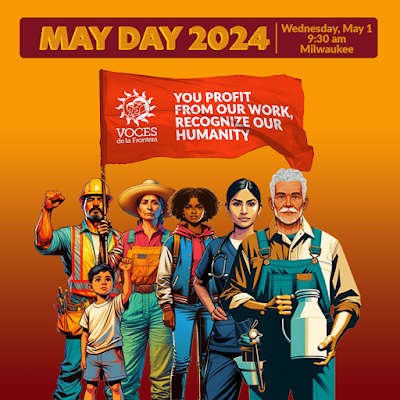
Voces de la Frontera's March on MAY DAY 2024: Wednesday, May 1, 2024

Gather at Voces' Office, 1027 S. 5th Street, Milwaukee, WI.  

March to the Fiserv Forum on 6th Street and Juneau Avenue


9:30 a.m.  RALLY AT THE VOCES' OFFICE

10:30 a.m.  MARCH TO THE FISERV FORUM

11:30 a.m.   RALLY AT THE FISERV FORUM


Monday, April 1, 2024

The Working Catholic, Immigration Part Three by Bill Droel


Archbishop John Hughes (1997-1864) of New York is probably not a suitable role model for a bishop today. And yet…

Hughes was born in Ireland. He once tellingly wrote: For first four days of my life, I was “on social and civil equality with the most favored subjects of the British Empire.” But then I was baptized a Roman Catholic.

Hughes emigrated to the U.S. in 1817 where he worked in a quarry and in landscaping. He was eventually ordained for the Philadelphia diocese and within 12 years was appointed as a bishop to New York City. From the time he arrived on these shores, Hughes strongly felt that Catholicism was in harmony with our Constitution and our democratic ideals. He was consistently positive about pluralism, the electoral process and the law. At the same time, Hughes was a controversial opponent of certain assumptions and attitudes embedded in the dominant culture of his day. Using today’s term, Hughes was a cultural warrior.

Machine Made:  Tammany Hall by Terry Golway (W.W. Norton,  2014) explains the tension that made Hughes a champion of immigrants and a threat to others.  The dominant culture of his time was associated with New York's elites, with evangelical Protestants.  They fancied themselves as reformers, as technocrats.  They knew what was best for society.  But Hughes judged them to be an outdated aristocracy whose hypocrisy denied opportunities to immigrant families.  He saw heavy-handed moralizing in their campaigns for temperance, child welfare and the like.  In fact, to him their notion of social improvement was anti-Catholic, anti-Irish American.

Concurring with the First Amendment of our Constitution and anticipating a key insight of Vatican II (1962-1965), Hughes believed that a religion does better within pluranlism than in a theocracy.  "There is no such thing as a predominant religion" in the U.S., said Hughes.  Ours is not "a Protestant country or a Catholic country or a Jewish country or a Christian country in a sense that it would give any sect or combination of sects the right to oppress any other sect."  A minority, he continued, 'is entitled to the same protection as the greatest majority."  further, a minority has 'the right to reject the values of a dominant culture."  

Hughes was best-known for applying his understanding of the Constitution to education. To Hughes, as Golway writes, the public schools “were imbued with Protestant assumptions and attitudes.” Hughes judged that they were sectarian and thereby undermined our Catholic style of Christianity. The school system “conveyed cultural disrespect.” Hughes first attempted to gain public funding for a small number of parish schools, but his political and legal efforts were thwarted. Hughes then concentrated on bricks-and-mortar. “Build our own schools first,” he said. Church buildings can come later. Today, Hughes is considered a founder of the Catholic school system through which thousands upon thousands of immigrant children and their descendants have moved into the mainstream.

Hughes “was outspoken, aggressive and political to his very marrow,” Golway writes. His nickname was Dagger John. His style would not go over among Catholics today, accustomed as they are to breezy, polite clergy. Further, his style is unacceptable in post-Vatican II theology in which lay people, not Church employees, are expected to be competent leaders in civic affairs. But Hughes’ insights are still relevant.

§  The Gift of Immigrants. All immigrant groups are, allowing for a period of adjustment, a source economic growth and social energy for our country.

§  Genuine Pluralism. People learn and exercise virtues through the give-and-take of family life and in their particular parish/neighborhood. By contrast, the diversity movement in our schools and businesses does not help people find meaning or propel them in society. As it turns out, Catholic particularity within ethnic communities and parishes makes for citizens sensitive to the greater good.

§  Disabling Help. Many immigrant families arrive in the U.S. needing resources. When government funds are involved, self-sufficiency stalls. Instead of dealing through a bureaucracy, help is ennobling when it is funneled through proximate institutions (ethnic networks, a parish, a precinct, an independent settlement house, a neighborhood clinic and a union hall or worker center).

§  Quality Education. The mix of races and ethnicities in today’s public schools can encourage social awareness and genuine tolerance. So too with the philosophy of a Catholic school—more so these days because those schools admit a significant number of non-Catholic students and a number of Black students.

§  Religious Liberty. Our Constitution’s First Amendment is a two-way street. Government shall not meddle in a church’s religious affairs nor favor any one religion. No distinctive religious doctrine shall dominate any part of government. In the other direction, when clergy and other Church leaders enter the public square they must argue their positions in civic terms. Catholic clergy must stop short of partisanship. (Hughes admittedly inched over the society-partisan politics boundary by running a slate of local electoral candidates.)

Droel edits a printed newsletter on faith and work, INITIATIVES (PO Box 291102, Chicago, IL 60629)


Tuesday, March 12, 2024


Thursday, February 29, 2024

The Working Catholic: Big Tech by Bill Droel


The popular use of a term sometimes differs from its original use. Such is the case with Luddite, which now usually refers to someone who fiercely opposes most technology. Blood in the Machine by Brain Merchant (Little Brown, 2023) takes us back to the term’s origin: the Luddite Movement in England from 1811 to 1816.

Textile workers were opposed to certain types of automated machines, not wholesale opposition to all technology. They also believed that employers deceived them about manufacturing changes. The workers damaged some factory machines, but eventually lost their battle when military force was used against them.

In our day, some tech companies warrant resistance over their treatment of employees and consumers. Those companies include the social media--Meta (Facebook), Tik Tok, and X (Twitter) and others. Plus, the big tech retail giant Amazon and probably the app-based delivery/rider companies.

The harmful side effects of these companies derive from their operating philosophy, as summarized by Adrienne LaFrance in “The Despots of Silicon Valley” for The Atlantic (3/24). The authoritarian titans of tech are dangerous, she writes. They believe “that technological progress of any kind is unreservedly and inherently good; that you should always build it, simply because you can; that frictionless information flow is the highest value regardless of the information’s quality; that privacy is an archaic concept…[and that] the power [of tech experts] should be unconstrained.”

LaFrance continues: The tech giants “promise community but sow division; claim to champion truth but spread lies; wrap themselves in concepts such as empowerment and liberty, but surveil us relentlessly.”

Our Congress is concerned about the side effects of big tech. Both House and Senate routinely summon one or another tech executive to address those concerns. Those hearings are perhaps a modest start. Collective and individual action on the part of the public is urgently needed. A few groups are on the case. For example, Collective Action in Tech (www.collectiveaction.tech/unions) maintains a list of organizing efforts among employees in the big tech sector. Mothers Unite to Stall Technology (www.mothersunite4kids.org) advises parents on the harmful effects of mobile devices and more. (Ironically, these citizen efforts rely on tech platforms to spread their ideas.)

 Citizens should keep basic principles in mind. First, as Jacques Ellul (1912-1994) warns us, all technology individuates. Contrary to the propaganda of the social media platforms, communication through mobile devices puts users further apart. One’s so-called friends on Facebook are likely not genuine friends unless honest and vulnerable face-to-face contact also occurs. Second, as Marshall McLuhan preaches, “the medium is the message.” That is, the content is less relevant than the hardware (the device itself, the satellite and the earthbound transmitters and cables). Merely having a TV in one’s home changes the household environment, no matter the content of one or another TV show. A mobile device in one’s pocket changes one’s outlook, no matter who is texting whom.

These principles and others should, by the way, cause reflection on the part of church leaders—particularly those in liturgical denominations. For example, a camera inside a church in itself makes the worship a little bit more entertainment and a little less participatory liturgy. Say it this way: There is no such thing as reality TV or reality streaming. The image from a camera signal sent up to a satellite and back down to a TV, a computer or a mobile device is not reality. It is a projection and it necessarily individuates.  Be honest: Do you drink coffee or surf channels while watching TV Mass?

Droel is the author of Public Friendship (National Center for the Laity, PO Box 291102, Chicago, IL 60629; $6)

Friday, February 23, 2024

St. Francis Cathedral Basilica, Santa Fe, New Mexico

with symbols of theologies of faith, expecting understanding


After meeting our London family in Las Vegas we visited Santa Fe, New Mexico.  It was an exciting trip.

Our grandchildren learn about the beauty of nature by cuddling a large snake. 

  We learned more about the Native Americans of the Southwest and the Spanish culture that violently dominated them. 


Our visit to the Cathedral for Mass was enlightening for us.  Archbishop Wester presided.  His homily was excellent.  In my opinion, it seemed it was based on the Creation Theology of M. D. Chenu, O.P.  He opened with a quote from Elizabeth Barrett Browning:  

 Earth's crammed with heaven,

And every common bush afire with God,

But only he who sees takes off his shoes;

The rest sit round and pluck blackberries.

     From Aurora Leigh, by Elizabeth Barrett Browning

His words were meant to spark meditation for Lent.  The question is, did this indicate a ‘me and God Theology?’ 

Moses was given the duty to liberate the Jews from slavery.  In Exodus, God speaks to Moses:  “I have heard their outcry against their slave-masters…you shall bring my people Israel out of Egypt.”  (Ex 4:7-10) 

Could there have been more said by the Archbishop considering the crises we now face?  It was the week of the Novalny murder.

The Cathedral as it is now is reminiscent of an older adobe church, La Parroquia, (built in 1714-1717). A side chapel contains a statue of Our Lady of the Conquista. The current building was constructed in 1859-1886.  The structure of the building and its accoutrements present an eclectic series of theologies including Vatican II. 

A statue of Kateri Tekawitha, Native American Saint, is in front of the Saint Francis Cathedral Basilica in Santa Fe, New Mexico.

The people of the congregation were very kind to us.  Because of my handicapped situation, Communion was brought to us.  Some talked to us and asked where we were from. It was indeed a Post-Vatican community.