Monday, March 9, 2020

Presidents – The Law, and the Critique of the Social Democrats


The Declaration of Independence states the reasons and the goals for the formation of the United States of America.  The Constitution dictates the legal structure for the U.S. and is subject to amendment.  The founding fathers chose to form a democratic society of citizens as opposed to a society of subjects to a King.

Karl Marx in his essay ‘On the Jewish Question’ pointed out that the rights designated in the Constitution established property rights for individuals, but not the basic rights of all as equal citizens in political discussion.(Rupert)  Lincoln dramatically changed the structure of the country with his Gettysburg Address and passage of the 13th Amendment eliminating slavery.

Abraham Lincoln
  The 14th Amendment passed after Lincoln’s assassination established that all born in the U.S. were citizens.  This meant the potential for political involvement of those not permitted previously.

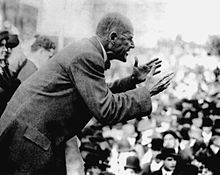
In the name of ‘We the People’ Lincoln did expand executive power by suspending the rule of habeus corpus to prevent Confederate sympathizers the right of a trial.  Other Presidents also expanded executive power but not in the name of ‘We the People’ but in the name of ‘some of the people.’  An example would be Theodore Roosevelt in his battle with labor and Democratic Socialist Eugene Debs.  Roosevelt was considered a progressive for attempting to reign in large corporations so as to protect the property rights of others, but he was reluctant to give labor an equal footing in law and politics. Eugene Debs saw politics and society differently.  Debs was a Socialist.  His conversion to the party was largely because of Victor Berger of Milwaukee, the first Socialist elected to Congress.  Frank Zeidler the last Socialist Mayor of Milwaukee defined Socialism with the following comment in an introduction to a two volume work on Wisconsin Socialism:

“The socialist movement was inspired by the hope of a brotherhood of workers, the Cooperative Commonwealth; by a fierce opposition to war; by a belief in the rights of people; by a passion for orderly government ; and a contempt for graft and boodling.” (Beck) 

(Boodling is a term used by Lincoln Steffens of McClure’s Magazine in an article published in 1902 exposing corruption in municipal governments.   He defined ‘boodling’ as a form of corruption that ‘involves not thieves, gamblers, and common women, but influential citizens, capitalists and great corporations.  The stock in trade of the boodler is the rights, privileges, franchises, and real property of the city… (Beck) 

Frank Zeidler
Zeidler used the appellation ‘social democrat’ in his essay.  A Socialist Party pamphlet offers an explanation:
“The Socialist Party strives to establish a radical democracy that places people’s lives under their own control …The economy is democratically managed for the benefit of all humanity, not for the profit of the few.” (Socialist Party USA)

Eugene Debs was nominated as the Social Democrat candidate for president in 1900 along with Job Harriman of the Socialist Labor Party for vice president.  Debs received 100,000 votes in the year 1900, 402,283 in 1904, and 420,713 in 1908. 
   
Trial of Labor Leaders:  Theodore Roosevelt vs. Eugene Debs

Three leaders of the Western Federation of Miners were spirited out of Colorado without a warrant to face murder charges in Idaho.  The three were Secretary-Treasurer, William Haywood, President Charles H. Moyer, and former union activist and business man, George Pettibone.

The former governor of Idaho Frank Steunenberg was murdered by Harry Orchard in 1905.  Orchard claimed that the defendants paid him to kill the governor. Orchard testified that the Union officials had paid him to murder Steunenberg as a payback for the governor’s active and illegal opposition to them in a mine strike at Coeur d’Alene in Northern Idaho in 1899.  The strike became violent and Steunenberg asked President McKinley for Federal troops.  Every union man in the area was arrested.  The men were herded into a bull pen with poor sanitary conditions.  Steunenberg dictated that all members of the union were guilty and no man could work in an Idaho mine unless he renounced his allegiance to the Western Federation of Miners.

Theodore Roosevelt

Roosevelt was adamant in his defense of Capitalist property rights.  In a speech during a ceremony laying a cornerstone, Roosevelt implied that Haywood, Moyer and Pettibone were guilty of murder.  Democratic Socialist Eugene Debs responded in an open letter.

“Permit me to ask you, Mr. President, how you know that these men are implicated in murder?  Have they been tried and found guilty by due process of law? (Debs)

Eugene Debs
Roosevelt made public a letter he wrote to a congressman in which he describes Debs, Moyer and Haywood as ‘undesirables.’  Thousands marched in the 1907 New York City May Day parade with buttons inscribed ‘I am an undesirable.’(Lukas)   Roosevelt had a personal issue with the Western Federation of Miners because a fellow Rough-rider, Sherman Bell, was named General of the Colorado National Guard by Governor Peabody.  General Bell was involved in the violent and illegal suppression of a strike in Cripple Creek Colorado.  Bell was Roosevelt’s body guard in his campaign for vice president in 1900.  J. Anthony Lukas quotes General Bell in his book Big Trouble:

“When asked how he planned to proceed against the Western Federation of Miners, he said, ‘I came to do up this damned anarchistic federation.’  ‘My orders were to wipe ‘em off the face of the earth.’”

In the summer of 1907 Haywood, Moyer and Pettibone were found not guilty; Clarence Darrow was their lawyer.

The Sewer Socialists

Lincoln recognized that the time for slavery was over but he also knew that the equality expressed in the Declaration of Independence was in the future.  At Gettysburg he said, “It is for us the living, rather, to be dedicated to the unfinished work which they who fought here have thus far so nobly advanced.”  His interference with the law was based on the ‘We the People’ phrase of the Constitution.  He saw his duty to protect the Union as established by the people of the United States.  The renunciation of some States was not a legitimate Constitutional right.  
The Democratic Socialists mirror Lincoln’s view on the tension between the practical and the ideal.  Milwaukee Democratic Socialist Mayor Frank Zeidler wrote:

“The application of political theory to the practical problems of government always presents problems for both party theoreticians and party practitioners.  The socialist movement in Wisconsin did not escape the anguish of trying to participate in government and yet to reconcile political necessity with democratic socialist theory.” (Beck)

Zeidler continues by noting the Milwaukee Socialists did not mind being called Sewer Socialists by the theoreticians because they achieved many benefits for the city and state such as labor laws which eventually became national policies with Franklin Roosevelt’s New Deal.  During a shortage of moderate priced housing Socialist Mayor Hoan started the first low income housing project in the nation; it was called Garden Homes and completed in 1923.  

Emil Seidel

The houses still exist, however, the neighborhood has experienced years of disinvestment.  In recent times the neighborhood association has been working to restore this historic district.  Former and first Socialist mayor of Milwaukee, Emil Seidel (1910 - 1912 ), was one of the occupants of the housing project.


Milwaukee 2020

The Democratic Convention in Milwaukee in 2020 couldn’t be more important.  A candidate must be chosen who can win against an autocratic president who has proven to be an effective demagogue.   Also the immediate existential threats of climate change and nuclear war must be addressed without hesitation.  Related problems of refugees and migration need to be looked at with a perspective that - all are created equal.  Concerning the economy, have workers once again become expendable in a new technological society?  Are workers expendable as consumers in a society split into the ‘haves’ and the ‘have not’s’?  Isn’t the need for single payer health care more obvious with the coronavirus looming?  What about gun control?  Should the power of the Presidency be used to help solve these problems?

References

Elmer A. Beck, The Sewer Socialists, (Vols I&II) Westberg Associates Publishers, Fennimore, Wisconsin, 1982
Eugene V. Debs Speaks, edited by Jean Y. Tussey, Pathfinder Press, New York, 1970
John Gurda, The Making of Milwaukee, Milwaukee County Historical Society, Milwaukee, 1999
J. Anthony Lukas, Big Trouble, Simon & Schuster, New York, 1997
Mark Rupert, Producing Hegemony, Cambridge University Press, Cambridge, U.K., 1995.
Irving Stone, Clarence Darrow For the Defense, Doubleday Duran & Co. 1941
Socialist Party USA, “Socialism As Radical Democracy,” New York City, N.Y.
Gary Wills, Lincoln at Gettysburg, Simon & Schuster, New York, 1992

Sunday, February 23, 2020

Formation through Action by Bill Droel


“Consuming and participating in politics by obsessive news-following [and] by arguing and debating” is not politics, says Eitan Hersh in Politics Is for Power (Simon & Schuster [2020]; $27). To binge on MSNBC, devour Fox News or constantly share one’s opinions with friends and family on social media or in phone calls, is “to satisfy our own emotional needs and intellectual curiosities” but in itself serves no “serious purpose.”
Hersh calls the trap political hobbyism: Instead of electoral engagement (canvassing, participating in meetings, etc.), citizens pay lots of attention to political comings-and-goings.  By one survey, 83% of those who spend an hour or more daily on news consumption (TV, mobile devices, reading) spend no time on political activity. Nor does the majority ever act on a community problem. Hersh does not suggest that citizens abandon the news. Genuine activists are well-informed. However, it does not work in the opposite direction: News junkies are not active.
Genuine politics is when people volunteer in order to acquire power. They build relationships, win supporters and broker their power for some social improvement. Hersh, a young professor at Tufts University, is sympathetic toward students and other young adults who support causes. However, he supplies several cautions. Genuine politics might entail spirited protest, but protest in itself is not enough. Though one-off events appeal to young adults, genuine politics means a longer-term commitment to others.
Hersh’s term for shallow participation is slacktivism. This is any symbolic on-line activity or token action that conveys support but only fulfills an altruistic need. These shallow gestures put off the necessity to learn how to vote, how to canvass, how to build relationships. He furnishes fascinating studies about how wearing a button or T-shirt subjectively removes the obligation to do something.   
Political hobbyism is not neutral; it “hinders the pursuit of political power.” It puts attention on entertainment and melodrama. Similarly, it favors “short-term emotional highs,” pushing away the often boring process of real social change. It also favors ideological struggles in which all manner of policies become moral convictions over which there can be no compromise. Both citizens and electoral officials buy into this made-for-TV culture.
Hersh profiles several competent organizers. They are people of empathy who know that whining and yelling only narrow the base. They have no set script but are open to dialogue with anyone. They do not campaign around policy issues so much as they are disciplined about winning and holding power. They have “generous hearts” and exhibit patience.
Hersh’s examples come from electoral politics. He does though apply his theory to the withering of religious organizations, labor unions and civic groups. The phrase spiritual but not religious can typify a hobbyist. Whereas the word religion means to bind together, the hobbyist occasionally tries out spiritual practices like yoga or solitary meditation.
Specialized Catholic Action (capital A) was a worldwide movement in 1940s and 1950s. Its key insight was that faith formation must include action. Discussion groups, theology on tap speakers in the parish hall and Scripture reflections in the bulletin are fine. But adults do not grow in wisdom without action. The Catholic Action method was summarized in the slogan: observe, judge act. In particular Catholic Action said that young adults will be disposed toward Christianity through disciplined action around their concerns about work and relationships. It trained young adults to steadily organize like-to-like, student-to-student, worker-to-worker. Specialized Catholic Action used no gimmicks and promised no quick fix. It is difficult. Several formation programs (Renew, Christ Renews His Church, etc.) have solid content but nearly all stumble on the necessity for action.
Droel edits INITIATIVES (PO Box 291102, Chicago, IL 60629), a print newsletter about faith and work.

Tuesday, February 4, 2020

“WE HOLD THESE TRUTHS” – WHAT DOES IT MEAN?


The politics of today demand some philosophical analysis.  We are overwhelmed with alternative reality, alternative truth; ‘incredible’ has become a superlative for ‘credible.’ Views on Epistemology and Philosophical psychology need to be brought into the conversation.  We live in parallel universes; how is politics possible?

Consider the impeachment trial; should Trump be removed from office?   Are there facts that cannot be denied?  I don’t think I’m changing the subject by asking: will the revised NAFTA improve the situation of Mexican workers or is it more oppressive?  What about the environment?

Pilate asked, “What is Truth?” Jesus had said, “If you make my word your home you will indeed be my disciples, you will learn the truth and the truth will make you free.”   But, as Pilate, we have choice; we observe what we care to observe and we judge according to our own criteria; it is intentional.  The basic question we ask determines the answer. 

What is the really real? – Idealism – the supernatural overrules the natural. Puritans -John Winthrop, William Wilberforce
What are the causes? – Realism – nature can be known and nature is the criteria, Lincoln, John Courtney Murray, S.J., St. Francis of Assisi, Native Americans
What works? – Pragmatism, evil means are justified by a good end, research data is reality, Jefferson, Gillet, compassion can be a criterion.
Why me and not nothing? – Existentialism, my feelings are reality and the criteria
Why does only nothing make sense? -  Absurdism – Barbarism – might makes right, Donald Trump

In dialogue all five may converge with the same or similar answer. 

  John Courtney Murray, S.J. quotes from Thomas Gilby’s book, Between Community and Society:

“…The basic standard of civility is not in doubt:  ‘Civilization is formed by men locked together in argument.  From this dialogue the community becomes a political community.’”  (1)

Courtney Murray notes that this quote:

“..expresses the mind of Thomas Aquinas, who was himself giving refined expression to the tradition of classic antiquity, which in its prior turn had given first elaboration to the concept of the ‘civil multitude,’ the multitude that is not a mass or a herd or a huddle, because it is characterized by civility.” (2)

Nominalism and Realism

The philosophical question:  what does it mean that all men are created equal is a truth we hold? What is the value of human knowledge?  The question was asked by the ancient Greeks. Aristotle and Plato accepted the validity of human knowledge while Socrates and the Sophists gave little or no value to human thought.  In the middle ages the debate was between the Nominalists and the Realists. The Realists accepted the complete validity of knowledge; the Nominalists did not, or were skeptical.
   
The Nominalist Roscelin (1050-1120) was the opponent of ultra realism.  “Roscelin held that the universal is a mere word.” (3) His adversary was William of Champeaux, who held that universals had a being of their own; “… that every name or term supposes a corresponding reality.” (4) William of Champeaux (1070-1120), “… the same essential nature is wholly present at the same time in each of the individual members of the species in question.”  (5)
Moderate realists accepted the value of human knowledge but in itself universals were not a subsistent entity but relevant constructs. Examples would be the monk Abalard and probably his lover Eloise as well as Thomas Aquinas. 

Copleston, S.J. writes:
“… St. Thomas declares that universals are not subsistent things but exist only in singular things.” 
“The objective foundation of the universal specific concept is thus the objective and individual essence of the thing, which essence is by the activity of the mind set free from individualizing factors, that is, according to Thomas, matter, and considered in abstraction.” (6) The process of abstraction comes from the writings on psychology by Aristotle, provided by Muslim and Jewish theologians from works formerly not available in the West.  

For the sake of discussion, let us classify Idealists as followers of Plato, Realists as followers of Aristotle, Pragmatists as followers of the Sophists and Existentalists and Absurdists as followers of Socrates. None fit perfectly in a category and overlap but dominant tendencies are discernible.

In CONGRESS, JULY 4, 1776

The unanimous Declaration of the thirteen united States of America,
“We hold these truths to be self evident that all men are created equal, that they are endowed by their Creator with certain unalienable rights, that among these are life, liberty, and the pursuit of happiness.”

Here is the basis of political exceptionalism.
Let us look at what the writer of the document, Thomas Jefferson, intended and how Abraham Lincoln gave it new meaning at Gettysburg.

Thomas Jefferson, Principal Author of the Declaration of Independence

Lincoln had great admiration for Jefferson.  He wrote, “who [Jefferson] was, is, and perhaps will continue to be, the most distinguished politician in our history.”   “The principles of Jefferson are the definitions and axioms of free society…”   “[Jefferson] had the … capacity to introduce into a merely revolutionary document, an abstract truth, applicable to all men at all times…” (7)

But Jefferson as a pragmatist (What works is Good-True) supported the Constitution that upheld slavery.  He had denounced the slave trade and was forced to remove a complaint on King George III from the Declaration under pressure from delegates to the Continental Congress.  The sentence read, “He (George lll) has prostituted his negative for suppressing every legislative attempt to prohibit or to restrain this execrable commerce.”  (8)

Slave owners were amenable to the revolution and independence because of anti slavery sentiment in England led by William Wilberforce and the Methodists. (Idealists)
Lincoln was a realist and strongly influenced by Unitarian Transcendentalists such as George Bancroft and Theodore Parker. Ralph Waldo Emerson and other writers should be included.  They said that nature itself was a guide for moral decisions.  The ‘self evident’ was revealed by nature itself.  Lincoln and the others saw the Declaration of Independence as a road map to the ‘City on the Hill.’ (Winthrop 1630) The Constitution is the law, a practical document for now, but can be improved at the direction of the principles laid out in the Declaration. “It is self evident that all are created equal,” gives the document an international dimension.  J. Courtney Murray wrote:  “Today in fact as in theory, the national interest must be related to this international realization, which stands higher and more ultimate in political value than itself.”  (9)  The rights of Mexican workers must be part of any trade deal.  Also nature itself must be a priority.

The feeling that our politics presently put us in two separate universes is not new.  Let’s look at a book written by Ransom H. Gillet, Democracy in the United States, Appleton and Company, New York, 1868.

Gillet was a democratic politician. (Pragmatist)  He was a consultant for Presidents Van Buren and Polk, (Mexican War opposed by Lincoln) “and that no man living commanded more the respect of Chief Justice Taney.” (Dred Scott Decision – slaves are property) He did not like Lincoln and sympathized with the position of the South on Slavery. Gillet opposed secession because he thought that the issue of tariffs and States Rights could be negotiated and did not consider slavery as a cause for pressure on the ambitions of the South.

According to Gillet, “In principle he (Lincoln) was thoroughly anti-democratic …”  (10)
A quote in Gillet’s book on the Civil War from a southern gentleman, Hon. Cave Johnson, (March 2, 1862) on the cause of the war:  “When Andy Johnson (Lincoln’s V.P.) with fifty or one hundred thousand men is sent here for our governor, and Fremont is sent to abolitionize eastern Tennessee and West Virginia, can there be a doubt that subjection and abolishment of slavery are the main objects of the war.” (11)

A strong supporter of of the legacy of Jefferson in 1868 but saw the Constitution as the basic doctrine of democracy, Gillet wrote that adversaries of democracy propose “Laws higher than the Constitution have been proclaimed as the rightful rule of action, and necessity put forth as a source of superior power.”   (12)

Equality meant equality for property owners.  “EQUALITY THE ONLY HONEST BASIS FOR LEGISLATION”  heads a section in Gillet’s book.  (13) Concerns are simply economic yet in his first inaugural address Jefferson, quoted by Gillet mentioned “adoring an over ruling Providence.”   (14)

For Lincoln Equality meant the end of slavery.  Lincoln argued in a debate with Douglas:
“I agree with Judge Douglas he (the Negro) is not my equal in many respects-certainly not in color, perhaps not in moral or intellectual endowment. But in the right to eat the bread, without the leave of anybody else, which his own had earns, he is my equal and the equal of Judge Douglas and the equal of every living man.”  (15)

Current Politics

All six of the previously mentioned groups have their blind spots, but truth, knowledge of reality, can be achieved by all simply for survival.  Some refuse to distinguish between self interest and the common good, and therefore abuse of power is not an impeachable offence. 
Alexander Hamilton wrote in The Federalist:

“A well constituted court for the trial of impeachments is an object not more to be desired than difficult to be obtained in a government wholly elective.  The subjects of its jurisdiction are those offenses which proceed from the misconduct of public men, or in other words from abuse or violation of public trust. They are of a nature which may with peculiar property be demonstrated POLITICAL, as they relate to injuries done immediately to the society itself.” (16)
Refusal to recognize the obvious makes dialogue impossible. When obvious truth is contested we have reached the barbaric.

As noted earlier, Thomas Gilby, O.P. said that, “civilization is formed by men locked together in argument.” (17)   What is missing from the formula is men and women locked together in the celebration and thanksgiving for life.  Panis et vinum sunt veritas.  


Footnotes:
1.  John Courtney Murray, S.J., We Hold These Truths, Sheed and Ward, New York, 1960, p. 6.
2.  Murray, p. 6.
3.  Frederick Copleston S.J., History of the Middle Ages. Vol.2 Pt.1, Image Books, N.Y.1962, p. 164.
4.  Copleston, p. 162.
5.  Copleston, p. 168.
6.  Copleston, p. 175.
7.  Wills, Gary, Lincoln at Gettysburg, Simon & Schuster, New York, 1992, p. 142. 142                    8.  Richard B. Morris, Encyclopedia of American History, Harper&Brothers, N.Y., 1961,p.542 p.5  9.  Murray, p. 287.                                                                               
10.  Ransom H. Gillet, Democracy in the United States, Appleton and Company, N.Y., 1868, p.261.
11.  Murray, p. 268.
12.  Murray, p. 6.
13.  Murray, p. 121.
14.  Murray, p. 21.
15.  Wills, p. 98.                                                                                                                                   16.  Alexander Hamilton, John Jay, James Madison, The Federalist, The Modern Library, N. Y., Section 6, p. 425.

17.  Murray, p. 6.


Thursday, January 30, 2020

The Working Catholic: Baseball Ethics by Bill Droel


A woman in a friendly poker game is dealt a lousy hand. Nonetheless, she leans in with a sparkle in her eye. She bets with confidence. On her turn to draw cards, she requests zero. Her bluff or gamesmanship is part of poker. It’s normal, expected and ethical.
Her roommate, who is not playing, circles the table, replenishing drinks. Her roommate gives the woman a small cue about the prospects for the other players. This is cheating. Anyone who plays poker, even casually, knows what is acceptable bluffing and knows that hiding an extra card or getting outside information is cheating.
As the batter is rounding first, the second baseman pretends to get a throw from the right fielder, who is still fumbling in the corner. The batter/base runner halts and returns to first. This is bluffing. It’s normal, expected and ethical. The next batter uses a drug that supposedly enhances performance. This is cheating. Anyone who plays baseball, even on a sandlot, knows what is acceptable bluffing and knows that corking a bat or taking PEDs is cheating.
The Houston Astros know that a base runner can acceptably steal signs; that’s part of the game. They also know that hiding a camera or a buzzer or a telescope in the scoreboard or the outfield stands is cheating. Children know the difference. High-paid baseball executives know the difference.
If the rules of a game change, the boundary difference between bluffing and cheating can move. Some suggest that teams be allowed to have sign-recognition technology in the outfield stands. Presumably both teams will have this allowance. If such becomes the rule, sign-stealing by way of outfield devices is no longer stealing; it is technology-enhanced gamesmanship. It is also, by the way, no longer an advantage.
Any change along those lines, in my opinion, takes baseball further away from its natural setting and further into video-dimension and cyber-reality. Who needs umpires if the rules establish K-Zone as the arbiter? Who needs human players if a video game is no longer a simulation but is taken for the real thing? That’s one fan’s opinion.
Mike Fiers was on the Houston Astros through 2017, though he did not play in their World Series championship. He then went to Detroit and in August 2018 was traded to the Oakland A’s. There have been rumors about Astros’ cheating for some time, but in recent weeks Fiers told a journalist what he knew about hidden cameras and electronic devices in Houston.
Jessica Mendoza is an announcer with ESPN, mostly on TV. She is also a paid advisor to the New York Mets. On an ESPN radio show, Golic and Wingo, she expressed disappointment with Fiers for tattling. She thinks Fiers could perhaps have talked to the baseball commissioner, but should not have talked to the press.
A high school student knows that a classmate steals a Pepsi each day in the lunchroom. There is probably no need for tattling, for breaking the bonds of student solidarity. A parish priest knows that a fellow priest has improper contact with children. He does not immediately call the police. Instead, he presumes others know the situation and, despite many examples to the contrary, assumes the church bureaucracy knows best. A code of silence and a culture of secrecy soon bankrupt the entire church—financially and morally. Four police detectives know that a colleague has brutalized a suspect. They do not immediately notify the states attorney, presuming that the police bureaucracy will catch up if warranted. A code of silence soon enough erodes trust on the streets and endangers the safety of police and citizens.
Maybe the Astros are like high school students. The manager and general manager look like adults and are paid like adults. But maybe their code of silence is akin to high school shenanigans and, though it blemishes a cherished sport, maybe their behavior is not sufficiently grave.
Mendoza, to be clear, was not applauding Astros’ behavior. But she should know that cheating is different from bluffing; that cheating spoils a good game and it erodes trust in our aching society. Her radio comment about Fiers was inappropriate, particularly coming from a journalist.

Droel edits a newsletter on faith and work, INITIATIVES (PO Box 291102, Chicago, IL 60629)

Tuesday, January 7, 2020

THEOLOGICAL REFLECTIONS FOR A CHURCH IN CRISIS


SOURCES FOR THE FOLLOWING REFLECTIONS:


Leonardo Boff, Sacraments of Life-Life of the Sacraments,  Pastoral Press, Washington D.C. 1975

John Dominic Crossan, The Birth of Christianity, Harper San Francisco, 1999

William Droel, Patty Crowley–Lay Pioneer, Loyola, Chicago, 2016

Matthew Fox, Original Blessing, Bear & Company, Santa Fe, New Mexico, 1983 & A Spirituality Named Compassion, 1979

Gustavo Gutierrez, A Theology of Liberation, Orbis Books, New York, 1973 &  The Power of the Poor in History, Orbis Books, New York, 1983

Roger Haight, Christian Community in History, Vols. I&2, Continuum, New York, 2004

Hans Kung, The Church, Sheed and Ward, New York, 1967

Frederic Martel, In the Closet of the Vatican, Bloomberg Continuum, London etc. 2019

Matthew’s Gospel

J.M. O’Conner, O.P. Paul – A Critical Life, Oxford, 1997

T.F. O’Meara, O.P. & Paul Philibert, O.P.  Scanning the Signs of the Times, ATF Theology, 2013

Paul’s Epistles to the Thessalonians and the Hebrews

E. Schillebeeckx, O.P. The Eucharist, Sheed & Ward, New York, 1968

                                    The Church with a Human Face, Crossroad, N.Y. 1985

                                    Understanding of Faith, Seabury Press, New York, 1974


INTRODUCTION


In his Commonweal article, “When Bishops Meet,” by J. O’Malley, S.J., O’Malley notes that Vatican II “Proponents of change defended their position by making use of ‘ressourcement,’” back to the sources.

Vatican II brought about changes, but defended the priestly hierarchical structure of the Church.  Some Council bishops and theologians saw a problem, and looked to the Jesus community in Galilee and the early Church as a ‘ressourcement’ guide for the future.  Such a guide is important in the wake of current events.  It is so needed because of the pedophile crisis and the recognition by many of the faithful that the hierarchical structure is a catalyst and a cause of this crisis. James Carroll wrote in the Atlantic Monthly, “A power structure that is accountable only to itself will always end up abusing the powerless.” Changes that reaffirm the clerical structure assure the destruction of the Church as we know it.  Perhaps this would be for the best.
Please consider the following post-Vatican II reflections from the books listed above and a pre-Vatican II reflection by Antonin-Gilbert Sertillanges, O.P. who understood the historical nature of dogma in the early twentieth century and was part of the run-up to Vatican II:

Leonardo Boff, O.F.M.

“The sacraments are not the private property of the sacred hierarchy.” Boff, p. 7

John Dominic Crossan

 “Across twenty-five years of publications Koestler has emphasized, concerning such texts as the Q Gospel and the Gospel of Thomas, that, for example, faith is understood as belief in Jesus words, a belief which makes what Jesus proclaimed present and real for the believer”… Faith is not just in words but in the God who through words demands deeds. Crossan, p. 406 

John Dominic Crossan, in a chapter on Gender and Communal Equality quotes theologian Deborah Rose-Gaier from her paper on the Didache an early Church document: “there are no prohibitions recorded against women as trainers, baptizers, eucharistizers, apostles, prophets, or teachers so it must be assumed that those functioning roles within the community were open to women.” Crossan, p. 371

Crossan summarizes his section on Meal and Community: “…it is in food and drink offered equally to everyone that the presence of God and Jesus is found.  But food and drink are the material bases of life, so the Lord’s Supper is a political and economic challenge as well as a sacred rite and liturgical worship.” Crossan, p. 444 

Acts and Pastoral letters etc. used to support hierarchical vs. Charismatic structure of church.  Kung, p. 180, Crossan, Life Death Split

William Droel 

Patty Crowley Lay Pioneer, Loyola University, Chicago, 2016

Chicago St. Mary of the Lake Seminary Professor and CFM advisor Msgr. Reynold Hillenbrand repeatedly insisted that, “the basic theology of CFM and similar movements was centered in the correct understanding of the Mass as a corporate act.” Droel, p. 31


Matthew Fox

The key  to understanding compassion is to enter into a consciousness of interdependence which is a consciousness of equality of being.”  Original Blessing, p. 279  “Compassion is about feelings of togetherness suspended egos or the feeling of  kinship with all fellow creatures.   This kinship in turn urges us to celebrate our kinship.”  Spirituality Named Compassion, p. 14

 Gustavo Gutierrez, O.P.

“…theology of liberation offers not so much a new theme for reflection but an new way to do theology.  Theology as a critical reflection on historical praxis is a liberating theology, a theology of liberating transformation of the history of mankind…” A Theology of Liberation, p. 15

“He (Dietrich Bonhoeffer) had moved toward a theological outlook whose point of departure is in a faith lived by exploited classes, condemned ethnic groups and marginalized cultures.” The Power of the Poor in History p. 233

Roger Haight, S.J.

 Christian Community in History, Vols. I & 2, Continuum, New York, 2004

“On becoming the religion of the empire (Roman) the church began to be conceived in legal political terms; it was the legitimate religion of the empire.  Its political privileges urged it toward institutional totality and regimentation.  Increasingly church life became more passive and centered in liturgical cult and devotional practices. p. 247, Vol. 1                                                       

Reference to Schillebeeckx,  The Church with a Human Face, p. 142-43 

“When the formulations of the central doctrines of Christianity are recognized as examples of inculturation, they no longer appear as absolute or a-historical propositions, but as classic and paradigmatic examples of the principle of inculturation which cannot be bypassed because of the role they play in defining the church’s beliefs.”  p. 258, Vol. 1

“He (theologian Cameron, European Reformation, p. 148) describes the terminus a quo in terms of the priesthood that emerged out of the Gregorian reform (Pope Gregory VII, 1073-1085):  the priesthood was set apart from and above other Christians, by the indelible character or sacramental ordination, its legal privileges, ritual celibacy, clerical dress and tonsure, and above all by the sacrificial and miraculous ritual of the mass.” p. 75, Vol. 2

“Liberation theology, of course, is theology, that is an understanding of faith and of reality in the light of faith.” p. 411, Vol. 2 

“The discipline of theology attempts to mediate the understanding of the object of the Christian communities faith. As such it engages reflecting and thinking people.  p. viii, Vol. 1

Hans Kung

The Church, Sheed and Ward, New York, 1967

(Forward gives thanks to Tubingen colleague Joseph Ratzinger. Joe is referenced 5 times.  As Pope he took the name Benedict XVl.  The book is stamped, ‘Nihil Obstat” – no doctrinal error- Patrick Casey, Vicar General, Westminster, 1967)

“…the later Church cannot simply and totally exclude the Pauline constitution.  While it is unlikely to become a norm for the Church, this view might, even today, be of importance for certain missionary situations.  We cannot suppose that the Church of the present time would wish or would be able to prevent a recurrence of what happened in Corinth and other Pauline communities – the sudden outpouring of a charism of leadership through the freedom of the Spirit of God-given  particular and possible situations, for instance: a concentration camp, a remote prison from which there is no possibility of escape, or an extreme missionary situation, say communist China – Japanese Christians after all lived for centuries without any ordained pastors.  … What happens, for example, if a Christian finds himself in an extreme missionary situation, and then, under inspiration of the Spirit and on the basis of his priesthood as a believer, gathers together a small group, a little community, through the impact of his Christian witness,  baptizes them and celebrates with them the Lord’s Supper?  Can such a man, even though he has received no special commission from men, not be a charismatic pastor after the Pauline communities?”    Kung, p. 443      

“Faith in an ultimate and radical sense cannot properly be distinguished from love.  It is a personal activity directed towards a personal recipient.  Faith is never, in the final analysis, a matter of adherence to objects, rules or dogmas, but is the sacrifice and self giving of one person to another.  ‘What seems to be decisive in any act of faith is the the person to whose words approval is given.’ Thomas Aquinas, Summa Theologica II-II, q. 11, a. 1. 


“But radical personal self-giving, something in each and every case will be unconditional and irrevocable, can only be made to God; only God can be believed, in the fullest and most radical sense of the word.  To believe in a man in this absolute and completely unconditional sense would be to make him into an idol, only God can be believed, in the fullest and radical sense of the word.”  Kung, p. 31

“There appears to be no monarchical episcopate in the Pauline communities… There appears to be no ordination in the Pauline communities…” Kung, p. 402

“…the later Church cannot simply and totally exclude the Pauline constitution.  While it is unlikely to become a norm for the Church, this view might, even today, be of importance for certain missionary situations.  We cannot suppose that the Church of the present time would wish or would be able to prevent a recurrence of what happened in Corinth and other Pauline communities – the sudden outpouring of a charism of leadership through the freedom of the Spirit of God-given  particular and possible situations, for instance: a concentration camp, a remote prison from which there is no possibility of escape, or an extreme missionary situation, say communist China – Japanese Christians after all lived for centuries without any ordained pastors.  … What happens, for example, if a Christian finds himself in an extreme missionary situation, and then, under inspiration of the Spirit and on the basis of his priesthood as a believer, gathers together a small group, a little community, through the impact of his Christian witness,  baptizes them and celebrates with them the Lord’s Supper?  Can such a man, even though he has received no special commission from men, not be a charismatic pastor after the Pauline communities?”  Kung, p. 443       

“According to Acts, Chapter 2, the spirit has been poured out ‘on all flesh.”

“In a Church or community where only ecclesiastical officials rather than all the members of the community are active, ether is grave reason to wonder whether the Spirit has not been sacrificed along with spiritual gifts.”  Kung, 187 

“The fundamental error of ecclesiologies … was that they failed to realize that all who hold office are primarily not dignitaries but believers, members of the fellowship of believers; and that compared with this fundamental Christian fact any office they may hold is of secondary if not tertiary importance. … Does this mean that community precedes ecclesiastical office, or that the community rather than the office is the higher authority?  There is no question of having to make a choice in the new testament, where we find both community and office represented as equal authorities … “ Kung, p. 363   


“The charisms of leadership in the Pauline Churches did not at all events produce a ‘ruling class’, an aristocracy of those endowed with the Spirit who separated themselves from the community and rose above it in order to rule over it.” Kung, p. 187

“In more precise terms: on the one hand, faith as man’s act of radical self-offering and trusting acceptance of grace, is a condition of baptism.” Kung, p. 207                                                           

“According to Acts, chapter 2, the spirit has been poured out ‘on all flesh,.”  “In a Church or community where only ecclesiastical officials rather than all the members of the community are active, ether is grave reason to wonder whether the Spirit has not been sacrificed along with spiritual gifts.”  Kung, p. 187


“All the faithful belong to the people of God; there must be no clericalization of the Church.”  Kung, p. 125

“The charisms of leadership in the Pauline Churches did not at all events produce a ‘ruling class’, an aristocracy of those endowed with the Spirit who separated themselves from the community and rose above it in order to rule over it.”  Kung, p. 187


“Acts and Pastoral letters etc. used to support hierarchical vs. Charismatic structure of church.”  Kung, p. 180 


“In more precise terms: on the one hand, faith as man’s act of radical self-offering and trusting acceptance of grace, is a condition of baptism.” Kung, p. 207


Frederic Martel                                                                                                                                 In the Closet of the Vatican, Bloomberg Continuum, London, 2019

“The Pope is a monarch.  He can protect the people he likes in all circumstances, without anyone being able to stop him.” Martel, p. 58

Pope Francis – “We are not a tyrant, but a Christian King, and our anger is subject to leniency.”  Martel, p. 97

Matthew’s Gospel

And call no man your father upon the earth: for one is your father, which is in heaven. Mt. 23:9

Jesus speaks about ‘Hypocrites’ – see vs. 13,14,15.

Jerome Murphy-O’Conner, O.P.  

“I Corinthians 11: 11-12 is the first and only explicit defence of the complete equality of women in the New Testament.”  “Paul overturned the traditional argument from the chronological priority of the male in the creation narrative by pointing out that the chronological priority of women in the birth of a male is just as much a part of God’s plan for creation.” J.M.O., p. 29             

 E. Schillebeeckx, O.P.

 The Eucharist, Sheed & Ward, New York, 1968.

“The Fourth Lateran Council (1215) used the term transubstantiation.”  p. 50 

“Both Bonaventure and Thomas, for example, presented it in the same way.  “…because a presence of this kind cannot come about unless it does so by means of a change of the reality of the  bread into Christ’s body, we must accept transubstantiation.” pp. 48, 49

The Church with a Human Face, Crossroad, New York, 1985.

“Furthermore, in the ancient church the whole of the community of believers concelebrated, albeit under the leadership of one who presided over the community; the Eucharist is a celebration by the community.” p. 145

Synod of Bishops on the Priesthood 1971

“…Bishops (aware) that their priests were caught up in a crisis of identity.” 

 “It is against this background of two powerful extremes, supernaturalism (and fideism) on the one hand and ‘horizontalism’ on the other, that we need to see the second ordinary synod.” p. 212

“This synod did not propose any kind of solution, because it still thought ecclesiologically in a dualistic way and therefore could not provide any meaningful correction on the one hand to supernaturalist conceptions and on the other to conceptions which saw ministry simply as a profession and which did not express its real religious depth, or passed it over.” p.212 

“The general result of this was a return to the one sided approach of the Council of Trent, understandable at that time, which ultimately associates the distinctive character of the official priesthood almost exclusively with the Eucharist and the hearing of confession.”     p. 219 

The Understanding of Faith, Seabury Press, New York, 1974

“Today faith insists that the believer pass through the ordeal of a new interpretation of his faith if he wishes to be faithful to the message of the of the gospel.” p. 3

“…the Christian message or kerygma can only be geared to what is common to all – an increasing resistance to the inhumane and a permanent search for the humane, a search that man himself tries to solve in the praxis of his life (even t

“As soon as we realize that the truth of revelation has not simply come to us out of the blue but that it is expressed as man’s interpretation of faith, with the result that revelation is fundamentally God’s word in human words;”  p. 36

“The significance of the acceptance of a new interpretation of faith by a local church should not be underestimated. Lumen Gentium 28, Ad Gentes 20.” p.71

“Theology is the critical theory of the critical praxis which has this intention (transcendence must be won again and again in the face of historical alienation) and therefore does not hesitate to use meaning and nonsense that have been discovered in man and society by the human analytical and hermeneutic sciences.”  pp. 154-5

Paul’s Epistles

“Ahora bien: es la fe la garantía (hypostasis) de lo que espera, la prueba de cosas que no se ven, pues por ella adquirieron gran nombre los antiguos.” Heb. 11:1

(Faith is the guarantee (unification) of that which is hoped for, the proof of things not seen.  It was for Faith that our fathers were praised.)

If the charisms of individual Christians were discovered and furthered and developed, what dynamic power, what life and movement there would be in such a community, such a Church.  ‘Do not quench the Spirit, do not despise prophesying.’ I Thes. 5:19 

Antonin-Gilbert Sertillanges, O.P.

“The action of the Holy Spirit is not exclusively to be found in our chiefs, although in this case they are promised a special assistance … (It) is diffused through the whole church, giving life to the faithful and breathing truth into them affording them grace and useful impulses, listening as well as speaking.”  (The church is not a solitary monarchy influenced by no one.)  “Is it an autocracy in the full and exclusive sense of the word?  Such a being would be a monster or a maniac.  Every regime of persons is modified by various collaborations without which it would become the most unsupportable tyranny.” Antonin-Gilbert Sertillanges, O.P.  The Church, 1917.  Scanning Signs of the Times. p. 14   

“The fundamental idea in Sertillanges is that all knowledge and every activity are permeated with religion.” Scanning Signs of the Times, p. 16